Thursday, September 9, 2010

HYUNDAI I10 RESTYLING (SPY)


Ok...questi fanali anteriori con il gioco ad onda sono proprio carini...
Prima sulla Elantra, poi sulla versione Europea della Accent, adesso anche sulla I10
Per questi marchi asiatici con pochi riferimenti stilistici storici...questi dettagli li aiutano distinguerli meglio dalla massa.

Wednesday, September 8, 2010

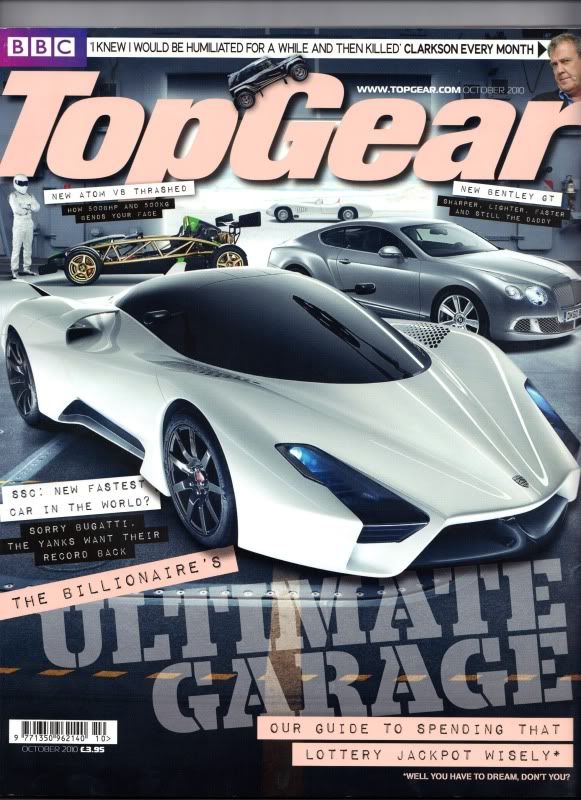
SSC ULTIMATE AERO (LEAKED)


Quanto e' Castriota questa supercar da 1350 Cv ..!!?!?

Mix tra Mantide e Birdcage con qualche nuova soluzione stilistica niente male per davvero.
Veramente molto innovativa (A differenza della precedente versione AERO, molto simile alla DIABLO)

PARIS 2010: OPEL ASTRA GTC PARIS CONCEPT


Bella,piena zeppa di bei dettagli, in parte gia' visti su altri modelli OPEL.
Credo che questo paraurti anteriore ce lo ritroveremo sulla prossima OPC/GSI ...
Il merletto della fiancata sul passaruota posteriore continua a lasciarmi un po' perplesso, ma forse ci vuole un po'di tempo per digerirlo.
Nel posteriore, credo che la parte inferiore del portellone che si amalgama in modo perfettissimo con il paraurti sara' difficile ritrovarlo sul modello di serie.
Cmq PROMOSSA a pieni voti.

PARIS 2010: CHEVROLET AVEO


Il frontale ha perso tantissimo rispetto al concept.....
Non capisco xche' a differenza della mascherina della Cruze/Spark e appunto del concept hanno deciso di posizionare la fascia orizzontale che taglia il singleframe cosi in basso.
Poteva essere molto , ma molto meglio.

Monday, September 6, 2010

How Not To Restore Confidence "Stress Test Edition"......

The main goal from "stress testing" the banks was to provide at least some confidence....There is now a good chance that this "PR Stunt" could backfire faster than even i predicted .....I´m not surprised that the rules for transparency were not "rigoros".... No wonder Only 35% Of Survey Participants Expect The Stess Test To Be Credible.... ...

Wenn man bedenkt das die einzige Aufgabe des Stress Test gewesen ist zumindest ein Mindestmaß an Vertrauen wiederherzustellen muß man so langsam befürchten das selbst dieses Mindestziel in Rekordzeit verfehlt wird..... Ich persönlich wundere mich nicht das die "Transparenzanforderungen" in Sachen Stress Test nicht "brutalst möglich" angesetzt worden sind......Kein Wunder das bereits bei Durchführung lediglich 35% der Befragten dem Stress Test "Glaubwürdigkeit" zugestanden haben....

[EUSTRESS]

Europe's Bank Stress Tests Minimized Debt Risk WSJ

Europe's recent "stress tests" of the strength of major banks understated some lenders' holdings of potentially risky government debt, a Wall Street Journal analysis shows.

As part of the tests, 91 of Europe's largest banks were required to reveal how much government debt from European countries they held on their balance sheets. Regulators said the figures showed banks' total holdings of that debt as of March 31.

An examination of the banks' disclosures indicates that some banks didn't provide as comprehensive a picture of their government-debt holdings as regulators claimed.

Some banks excluded certain bonds, and many reduced the sums to account for "short" positions they held—facts that neither regulators nor most banks disclosed when the test results were published in late July.

Because of the limited nature of most banks' disclosures, it is impossible to gauge the number of banks that excluded portions of their sovereign portfolios from their disclosures, or the overall effect of that practice.

But the exposure to government debt of at least some banks, such as Barclays PLC and Crédit Agricole SA, was reduced by a significant amount, according to industry officials and financial filings made by the banks. Adding to the haziness, the stress tests' reported sovereign-debt levels differed, sometimes widely, from other international tallies and from some banks' own financial statements.

The stress tests' upbeat results—only seven banks flunked, and were deemed short of just €3.5 billion ($4.51 billion) of capital—initially soothed markets. But fears have flared up again as heavily indebted countries like Ireland and Greece continue to struggle. Among other warning signs, the costs of insuring many bank and government bonds against default in countries such as Portugal, Ireland, Greece and Italy have jumped above their pre-stress-test levels.

The banks based their stress-test disclosures on a template provided by CEBS. The template asked for banks to disclose their "gross" and "net" exposures to sovereign risk in each E.U. country. Most banks' disclosures didn't define "gross" and "net" beyond saying that the latter were "net of collateral held and hedges."

But some banks' figures didn't represent their total holdings. Barclays, for example, excluded some government bonds it was holding for trading purposes. The rationale, according to Barclays officials, was that the bonds were directly related to transactions the big U.K. bank was performing for corporate or government clients, and that the holdings vary widely from day to day. Barclays didn't disclose that it wasn't listing its full holdings.

Excluding the bonds reduced Barclays' portfolio of Italian sovereign debt—which the bank said was £787 million ($1.22 billion)—by about £4.7 billion, Barclays officials said. The bank's holdings of Spanish government bonds, listed at £4.4 billion, shrank by about £1.6 billion.

The Barclays officials said they believe other big European banks also excluded significant slices of their trading portfolios from stress-test disclosures.

In its midyear results last month, Barclays reported its sovereign-bond portfolios based on a broader definition than the stress tests used. As a result, Barclays' reported holdings of debt issued by the Italian, Spanish and Irish governments swelled.

BIS data from March 31 indicates that French banks were holding about €20 billion of Greek sovereign debt and €35 billion of Spanish sovereign debt. In the stress tests, four French banks, which represent nearly 80% of the assets in France's banking system, reported holding a total of €11.6 billion of Greek government debt and €6.6 billion of Spanish debt.

Keep in mind that the even the most adverse scenario of the Stress Test didn´t include any hair cut on sovereign debt....Too bad that only 6 weeks later the market is already pricing in a restructuring of Greek Debt ( Greek Debt Crisis – Apocalypse Later )

Man sollte villeicht nocheinmal gesondert darauf hinweisen das selbst im schlimmsten anzunehmen Fall der "Strees Test" keinerlei Abschlag bei Staatsanleihen vorsieht....Dumm nur, das bereits 6 Woche nach Durchführung der Markt bereits zum Teil massive Abschläge eingepreist hat ( siehe Greek Debt Crisis – Apocalypse Later )

EU Rehn: Other 14 EMU Members To Cover Slovakia Greece Loans

The other 14 Eurozone countries will cover Slovakia's share of the E110 billion loan package to Greece after the country refused to participate, European Commissioner for Economic and Monetary Affairs, Olli Rehn said on Tuesday.

Slovakia originally agreed to participate in the E110 billion aid package for debt-laden Greece, but a new Slovak government decided to withdraw that commitment
Domino #2, Ireland, Set To Topple? ZH

The Irish-Bund spread is going nuts on reports that the ECB is bidding up sovereign debt once again, together with a WSJ report that the Stress Test was, as everyone with half a brain knew all too well, a blatant lie, and sovereign debt was misrepresented. Earlier, a report in the FT Deutschland suggested that the bailout of Anglo Irish alone, (not to mention AIB and Irish Nationwide) would be sufficient to threaten the country's solvency. Things domestically are no better, after a poll in the Sunday Independent found that 74% of respondents believed the country would default, and preceded earlier news that Irish consumer confidence plunged from 66.2 to 61.4.

Mmm, European yield stew FT Alphaville

Those bond markets and Irish debt Superb Video

Greek Deals Hidden From EU Probed as 400% Yield Gap Shows Doubt Bloomberg
Sept. 8 (Bloomberg) -- Four months after the 110 billion- euro ($140 billion) bailout for Greece, the nation still hasn’t disclosed the full details of secret financial transactions it used to conceal debt.

“We have not seen the real documents,” Walter Radermacher, head of the European Union’s statistics agency Eurostat, said in a Sept. 2 interview in his Luxembourg office. Eurostat first requested the contracts in February.
Beware of Greeks Bearing Bonds Michael Lewis / Vanity Fair
As Wall Street hangs on the question “Will Greece default?,” the author heads for riot-stricken Athens, and for the mysterious Vatopaidi monastery, which brought down the last government, laying bare the country’s economic insanity. But beyond a $1.2 trillion debt (roughly a quarter-million dollars for each working adult), there is a more frightening deficit. After systematically looting their own treasury, in a breathtaking binge of tax evasion, bribery, and creative accounting spurred on by Goldman Sachs, Greeks are sure of one thing: they can’t trust their fellow Greeks.

CEBS says the stress tests were JUST FINE FT Alphaville

Surprise, surprise....

Welch Überraschung....

Got GOLD ? ;-)

Bank Run "Kabul Edition"......

Should be no surprise that the name KARZAI is popping up again..... Some folks have learned quite a lot from us ( US & Europe ) when it comes to the play the "Bailout / Moral Hazard Game"...If this wouldn´t be so depressing one could almost "congratulate" the "fraudsters" for recognizing that this bank is definitely TBTF.... :-(

Das hier erneut der Name KARZAI auftaucht dürfte wohl nur noch die Bundesregierung überraschen..... ;-) Bei dem seit Jahren anhaltendem "Anschauungsunterricht" ( besondern in den USA & Europe ) wenig verwunderlich das praktisch weltweit das Thema "Bailout / Moral Hazard" ständig kopiert und wie in diesem Fall besonders "brilliant" gespielt wird...:-( Selten das eine an sich so kleine Bank ohne Zweifel der Kategorie "Too Big To Fail" zuzuordnen ist....


Afghans Move to Bail Out Kabul Bank WSJ
KABUL—Afghanistan's government inched closer to bailing out the country's largest bank, setting aside hundreds of millions of dollars that could be used to keep Kabul Bank solvent, officials said.

The move Sunday came as depositors continued to pull their money from the lender, mobbing branches in Kabul and other parts of the country. In the capital, police and soldiers were ordered to guard Kabul Bank branches and razor wire was strung outside the main branch to keep crowds in check.

Averting the failure of Afghanistan's largest bank, an institution with ties to President Hamid Karzai's administration, has become a priority for U.S. and Afghan officials concerned by the political and economic crisis that could result.

There were conflicting accounts of how much money the Afghan government was preparing to divert to Kabul Bank from its roughly $4.8 billion in foreign-exchange reserves. A central-bank official said the bailout would likely be in the $200 million range; a finance ministry official put the figure "closer to double that."

The central-bank official said several options were being discussed to recover the funds that are likely to be pumped into Kabul Bank. One option is forcing major shareholders who bought their stakes with loans from the bank to either repay what they borrowed or hand over their shares.

Another option is confiscating properties or businesses bought or built by bank insiders with loans from the lender.

Major shareholders include brothers of President Karzai and First Vice President Muhammad Fahim, U.S. and Afghan officials say. The "politics are delicate," the central-bank official said.

Finance Minister Omar Zakhilwal said the Afghan government Saturday transferred $100 million dollars to Kabul Bank to cover salaries for about 250,000 soldiers, police and teachers, who are paid through accounts at the lender.

Kabul Bank's woes became public late Tuesday, when word leaked that Afghanistan's central bank had forced out the lender's chairman and chief executive—its two biggest shareholders—amid allegations that they made hundreds of millions of dollars in sometimes-clandestine loans to themselves and Afghan government insiders.

U.S. and Afghan officials also say the bank used one of Afghanistan's traditional hawala money-transfer outfits to move hundreds of millions of dollars out of the country in an apparent attempt to avoid detection, though it isn't clear what the money was then used for.

On Wednesday and Thursday, depositors withdrew almost $180 million, more than a third of the $500 million the bank had on hand before the crisis.

It isn't clear if Kabul Bank's assets—mostly loans and property—are easily recoverable.
When bankers are more dangerous than warlords Felix Salmon
Speaking Wednesday from his villa in Dubai, which was paid for by Kabul Bank, Mahmoud Karzai, the president’s brother, said cash withdrawals from the bank were a “little bit more than usual” but did not threaten to cause a meltdown. A full-scale run on Kabul Bank, he added, “would be a major disaster.”

Yes, the president’s brother is a part owner of the bank, and he’s living in Dubai, in a villa paid for by the bank — which, incidentally, handles the payroll for Afghan soldiers and schoolteachers — and really, what could possibly go wrong?
Bill Black: “Control Fraud” Crushes Kabul NC
Kabul Bank has been revealed to be a “control fraud.” Control frauds occur when those that control a seemingly legitimate entity use it as a “weapon” to defraud. Control frauds cause greater financial losses than all other forms of property crime – combined. Control frauds can also cause immense damage to a nation because they are run by financial elites that curry favor from political elites. The result is that they are often able to loot “their” banks for years with impunity

The CIA tells us that Afghanistan raised roughly $1 billion in revenues last year and expended $3.3 billion. The shortfall, of course, was funded by us (the West, principally the U.S.). Indeed, that understates the case because Afghanistan raised the $1 billion in revenues primarily through customs duties and the U.S. and other Western nations indirectly or directly funded most of those customs duties.

We know certain facts. Afghanistan has no deposit insurance system. Its government has no financial responsibility for bailing out Kabul Bank’s depositors. Nevertheless, Afghanistan’s government has announced it will bail out the depositors. The funds to bail out the depositors will come – indirectly, but surely – largely from the United States Treasury
Karzai Family Political Ties Shielded Bank in Afghanistan NYT

In early 2009, as President Hamid Karzai scanned the landscape for potential partners to run in his re-election bid, he was approached from an unusual corner: a bank.

After the deal, Kabul Bank poured millions into Mr. Karzai’s re-election campaign, Afghan officials said. Mahmoud Karzai and Haseen Fahim, drawing on Kabul Bank’s resources, were able to enrich their families aided by tens of millions of dollars in loans.

“The brothers orchestrated the political deal to serve their business interests,” said a prominent Afghan businessman in Kabul who, like virtually everyone interviewed for this article, spoke only on condition of anonymity. “Fahim became vice president, and the bank financed Karzai’s re-election.

“In Kabul, politics is all about money,” he said. “It’s the same thing.”
FT Alphaville
Afghanistan’s central bank has stepped in to take control of the troubled Kabulbank, its governor said on Tuesday, after suspected irregularities raised concerns over the country’s top private financial institution.

Central Bank Governor Abdul Qadir Fitrat told Reuters investigations had also been started into the dealings of the bank’s top two directors and shareholders, who were told to resign, and a brother of Afghanistan’s First Vice President, Mohammad Qasim Fahim.

Friday, September 3, 2010

PARIS 2010: CHEVROLET CRUZE HATCHBACK CONCEPT


Speravo meglio...
Credo non spopolerà tra le medie in Europa...
Tra le Coreane preferisco la CEE'D