Friday, November 7, 2008

Revisiting China´s Sovereign Wealth Fund

Does anybody remember the buzz that Sovereign Wealth Funds would or could be the saviors of the financial market and especially the stock market around the world..... It seems that large part of the war chests (especially in China & Russia , and after this story No Kidding.... Dubai May Need Help To Repay Debt.... no one should expect miracles from the Middle Eastern petrodollars ....) are badly needed to bail out the domestic banking system & economy....... Just in time UPDATE: You can’t even depend on the SWFs via FT Alphaville

Kann sich noch einer an die Hyterie bezüglich der Sovereign Wealth Funds erinnern die drauf und dran waren die Lösung für die Kapitalmärkte und ganz besonders für die Aktienmärkte zu werden..... Es sieht ganz so aus als wenn die die zugegeben beachtliche Kriegskasse mehr und mehr dazu benötigen ( gilt besonders für China & Russland, und nach dieser Story No Kidding.... Dubai May Need Help To Repay Debt.... sollte man auch keinerlei Wunderdinge von den Petrodollars aus dem Mittleren Osten erwarten.... ) den heimischen Finanzsektor sowie einheimische Unternehmen "rauszuhauen"....... Passendes Update : You can’t even depend on the SWFs via FT Alphaville


WSJ

China's sovereign-wealth fund signed a deal to pump $19 billion into Agricultural Bank of China, part of a restructuring process that is expected to transform the bank into a stockholding company by the end of the year.

At least it could be that this "bailout/investment" from China Investment Corporation (CIC) is a better deal than their Blackstone & Morgan Stanley adventures.....

Immerhin hat das o.g. "Investment" ( oder besser gesagt Bailout ) der China Investment Corporation (CIC) gute Chancen ein besserer Deal als die Blackstone & Morgan Stanley Abenteuer zu werden.....

AddThis Feed Button

Wednesday, November 5, 2008

The "Accumulator".......

Another "innovative" product that is backfiring & will be eliminated very soon..... Being forced to double down ( if you want to spin it you can call it "cost average effect.....couldn´t resist....) in this market on a regular basis is indeed brutal..... But no mery they deserve the losses...... According to the journal this was the cause of the $ 2 billion Loss at CITIC ( see "Cowboy Hedging" Leads To $ 2 Billion Trading Loss.... )

Einmal mehr eine "Produktinnovation" die furchtbar nach hinten los geht und die es zukünftig sicher nicht mehr geben wird..... In regelmäßigen Abständen gezwungenermaßen in eine verlierende Position zu verbilligen ist so ziemlich das Gegenteil von gewinnbringend ( zu meiner aktiven Bank/Sparkassenzeit nannte man das im Fondsbereich bei noch "Cost Average Effekt"..... Vielleicht sollten die in Asien einfach mal die Vermarktung ändern.....). Da auch hier wieder Gier das Hirn gefressen hat hält sich mein Mitleid auch für die Privatinvestoren doch reichlich in Grenzen...... Lt. dem WSJ war auch die Art des "akkumulierens" die Hauptursache für den 2 Mrd $ Verlust von Citic ( siehe "Cowboy Hedging" Leads To $ 2 Billion Trading Loss....)

WSJ HONG KONG -- Amid widespread losses investors have suffered in the global financial crisis, one financial product popular in Asia has surfaced as the culprit behind a painful destruction of wealth for individuals and businesses alike.

Called an "accumulator," it is essentially a contract that obliges investors to purchase a security, currency or commodity at a fixed price -- often set at a discount to prevailing market rates -- at regular intervals. When the market price is above the fixed purchase price, the investor makes money. When it falls below the fixed price, the investor loses, sometimes quite a lot. Contract terms typically last a year.

In Hong Kong, recent losses from stock accumulators have led to dozens of complaints to regulators and legislators from disgruntled investors. Chan Kam-lam, a Hong Kong legislator, says he has heard from 50 or so individual investors, many of whom say they didn't fully understand the risk or blame their private bankers for pushing them into the products. Some individuals he has talked to have lost as much as $25 million. ...

Accumulators are among a number of structured financial products and derivatives that were sold to investors during headier times, when their downside risk seemed remote, but which are now wreaking havoc on private portfolios and corporate balance sheets amid huge volatility in global financial markets.

A fairly new flavor of derivative, the accumulator has led to big losses in some unexpected places. Among them: the books of VeraSun Energy Corp., one of the top three ethanol producers in the U.S., which filed for bankruptcy protection Friday. VeraSun had entered into accumulator contracts linked to the price of corn -- ethanol's key ingredient -- that led to big losses when those prices plunged amid a broader downturn in the commodity markets.

Citic Pacific Ltd., a Chinese-backed conglomerate listed in Hong Kong, recently reported a possible loss of nearly $2 billion, or more, thanks to its investments in a currency accumulator linked to the Australian dollar, which has fallen sharply against the U.S. dollar in recent months. News of the expected loss has punished the stock and has forced the company's Chinese parent to offer a rescue loan package.
Among the hardest-hit victims have been wealthy individual, or "retail," investors who bought stock accumulators in Hong Kong, by far the biggest market for the product, according to bankers. Hong Kong's financial regulator, the Securities and Futures Commission, estimated earlier this year that about $23 billion in accumulators remained outstanding.

What made them so popular? For one, years of rising equity prices and a dearth of fixed-income alternatives in Asia stoked interest in a number of equity-linked derivatives, including accumulators. Many people also appeared attracted by what seemed at first glance to be a great deal: the ability to buy stocks at a discount to the prevailing market price. This enhanced the impression that a bank's private-wealth clients were getting an exclusive offer only available to a select group.

And during the bull run in stock prices, when accumulators were most popular, many investors consistently underestimated the risk of a major, long-lasting downturn in shares that could leave them dangerously exposed.

As investors once enticed by the "discount" on their shares saw their losses mounting, they developed a new nickname for the accumulator: "I kill you later."

"The fundamental flaw with nearly all structured products that were developed is something that I learned from my grandmother: You get nothing for free," says Kathryn Matthews, chief investment officer for Asia at Fidelity Investment Management Ltd., which doesn't operate a private bank or offer accumulators.
Some investors have settled quietly for undisclosed sums with their private banks, according to people familiar with those negotiations. Others have opted to cut losses and terminate the accumulators, by selling them back to private banks for far less than their original purchase prices. Still others are hanging on to those investments, hoping a market rebound will restore ailing account balances......

The accumulator got its start in Europe as a corporate product, designed primarily for companies looking to build stakes in one another without causing sudden spikes in the share price of the target company.

Later, when private bankers began marketing the product to retail investors, the Asian market proved a lucrative source of new business.

Here is how an accumulator might have worked for an investor interested in accumulating a large position in China Mobile, one of the country's biggest telecom stocks.

larger/vergößern
A year ago, China Mobile was trading around 142 Hong Kong dollars (US$18.32) a share. An accumulator might have offered investors the ability to buy 1,000 China Mobile shares every month for a price of HK$114, or 20% below market price. The contracts typically included a "knock-out" clause, which terminated the contract once the stock appreciated 5%, or in China Mobile's case reached HK$149. If the stock reached that level, the return on the investor's outlay was 31%.

But here's the rub: Investors were contractually obliged to keep purchasing the shares at HK$114 regardless of whether they rose or fell. There was another nasty twist: Many accumulators required investors to double down on purchases if shares dropped, buying 2,000 shares instead of 1,000 at a price that now put them in the red.

For the 12-month accumulator, set in November 2007, investors quickly found themselves in this situation, as China Mobile's stock bounced around in the market's volatility. On Wednesday, the company's shares closed at HK$71.60 -- down 37% from the HK$114 purchase price. And because the investor is locked into making more purchases over the life of the contract, he keeps adding to his losses with each purchase.

AddThis Feed Button

Tuesday, November 4, 2008

No Nigerian Princes at the Fed..... :-)

LOL! The fact that the scamsters have shifted from Nigeria, Petro$ etc. to the Fed speaks volumes......That´s what can happen if you launch a new lending facility almost on a weekly basis and politicians & Fed are talking about bailouts for everyone an a daily basis...... The Fed balance sheet is already looking like some kind of scam......

Genial! Alleine die tatsache das die "Nepper,Schlepper,Bauernfänger" Ihren Fokus von Nigeria usw auf die Fed verlegt haben spricht Bände.....Man stelle sich mal vor die Bundesbank oder die EZB müßte per Pressemitteilung auf eine ähnliche Situation hinweisen. Das passiert aber wohl wenn man beinahe im Wochentakt neue Kreditlinien aus dem Hut zaubert und die Politiker & Notenbänker tagtäglich Bailouts für alle und jeden versprechen ..... Beim Anblick der Fed Bilanz würden ein paar mehr Programme auch nicht mehr ins Gewicht fallen..........


Real Time Economics / WSJ
The Federal Reserve Board Board released a statement today warning consumers about a phishing scam that invokes the central bank’s name in an effort to bilk people out of their money.

The fake emails promise consumers access to loans through a nonexistent Fed lending program. Consumers are encouraged to deposit large sums of money into a bank account, under the guise of a security deposit, in order to receive the purported loan. Of course, the Fed doesn’t lend directly to consumers.

“Consumers are strongly urged to verify the legitimacy of potential service providers before entering into a business transaction,” the Fed said. “Individuals seeking personal finance options are encouraged to do business only with reputable lenders and to shop around for the most favorable loan terms.”

AddThis Feed Button

More On China´s Slowdown......

Havn´t heard the word decoupling for a long long time....... It will be interesting what will happen to the population will react when the slowdown intensifies ( i think it will ).... This can easily spread into trouble for the communist party..... UPDATE via Naked Capitalism Roubini Foresees Chinese Hard Landing

Könnt Ihr Euch noch an die schöne These erinnern das China sich vom Rest der Welt abkoppeln kann..... Denke es wird sehr interessant zu beobachten wie die Bevölkerung auf einen dramatische Verlangsamung des Wachstums reagieren wird.....Bin mir ziemlich sicher das die schon jetzt vorhandene Unzufriedenheit leicht explodieren könnte. In der Verlangsamung liegt also ein gewaltiges Maß an politischem Sprengstoff.... Bleibt zu hoffen das die kommunistische Partei Ihre bereits jetzt höchst fragwürdige Politik nicht noch weiter "überzieht"....... Passend hierzu via Naked Capitalism Roubini Foresees Chinese Hard Landing

WSJ Mount Gibson Iron Ltd. said three Chinese customers have defaulted on long-term iron-ore purchase agreements, but that two other buyers have agreed to step in -- albeit paying a much lower price. In addition, the new buyers, which are already shareholders, agreed to underwrite a capital-raising effort and they could end up owning as much as 40% in the Australian miner.

Mount Gibson said the new sales agreements were struck at a much lower price and its profits would take a "material" hit in the financial year that ends June 30, 2009.

The Australian company's willingness to accept a much lower price for its ore, at least over the next couple of months, shows how quickly a global slowdown has pegged back China's economy, forcing Chinese steel mills to slow production and pushing down iron-ore prices.

UPDATE via Bloomberg Scrap-Steel Buyers Cancel Purchases as Prices Tumble

AddThis Feed Button

Monday, November 3, 2008

Massive Redemptions Are Forcing German Property Funds To Freeze € 34 Billion Or 40% Of Assets Under Management

As of today the halted redemptions for the open property funds ( closed property funds have a volume that far exceeds the € 89 billion ) are limited for 3 month. It wouldn´t surprise me if we will see the other major players to follow very soon. The last time this has happened in 2005 with one fund from Deutsche Bank the investors were not hurt because Deutsche has used the freeze to unload several portfolios to private equity players ( what a surprise ... to see how massive the inflow of foreign money was see German Commercial Real Estate 2006 / Or How The Rolling Bubble Effects Germany ) . They were able to sell at a premium to the book value. If they really have to sell assets in this kind of market to meet the redemptions the result will be disastrous.

Momentan sind die Aussetzungen auf 3 Monate beschränkt. Ich könnte mir gut vorstellen das die anderen Spieler wie die Deka usw demnächst ähnliche Maßnahmen ergreifen müssen. Als die Deutsche Bank das erste Mal überhaupt einen Immobilienfonds im Jahr 2005 vorübergehend schließen mußte war das für die Anleger sogar positiv. Die Deutsche Bank nutze die Phase um diverse Objekte oder ganze Portfolios an damals noch flüssige Private Equity Spieler ( welch Überraschung... Um zu sehen wie stark dieser Einfluß war empfehele ich einen Blick auf folgendes Posting zu werfen German Commercial Real Estate 2006 / Or How The Rolling Bubble Effects Germany ) zu verkaufen. Diese Verkäufe gingen allesamt zu einem Preis über den Tresen der deutlich über den Buchwerten lag und so den NAV massiv erhöht hat. Sollten die Immofonds aber nun gezwungen werden in einen fast ausgetrockneten Markt ohne ausreichende Finanzierungsmöglichkeiten hinein zu verkaufen um die Rückzahlung der Anteile zu gewährleisten dürfte es weniger glimpflich ausgehen.......

Add to this the commercial real estate problems coming from the banking loan book and i can smell fire sale prices if they are really forced to liquidiate their portfolio...........

Wenn man jetzt noch miteinbezieht das die Preise sowieso schon durcj die Probleme in den Kreditbüüchern der Banken unter Druck geraten kann man sich leicht ausmalen was passiert wenn die Fonds in diesen Markt liquidieren müssen.....

FT Alphaville

Amongst the worrying features in the property market, we flag significant debt to refinance (€200bln over next 12m), significant assets for sale (€340bln over next few months we estimate, with potentially depressing impact on prices); 25% average value decline (as forecast by our European Property team, by June-09) fast eroding the banks’ cushion as LTVs move from 65% to 87%.

The banks on Tondi’s European watch have €1 trillion of on-balance sheet exposure to commercial real estate, equivalent to 12 per cent of their loan book or 1.76 times their equity base. Oh, and there’s still €43bn of CMBS.

Usually the cash portion of the portfolio is over 20 percent but some of the cash is already tied to fund new projects. Sio the net liquidity position is probably closer to 10 percent..... It is also important to note that big parts of the portfolios are international and not tied to the German market.Unfortunatley the diversification from the bubblefree German market to the mostly inflated foreign markets has happened at the worst possible time ( 2004 -2007)......

Positiv zu erwähnen ist sicher das alle großen Fonds ca. 20% oder mehr an liquiden Mitteln vorhalten und so ein gewisser Puffer besteht. Allerdings muß beachtet werden das einige dieser Mittel auch schon zweckgebunden für neue Objekte sind. Die Nettoliquiditätsposition leigt damit wohl eher um die 10%......Zum besseren Verständnis weise ich nochmal ausdrücklich darauf hin das große Teile der Portfolios international investiert sind. Leider ist ein Großteil der Umschichtungen (um die Abhängigkiet vom bubblefreien deutschen Markt zu verringern ) zu Spitzenpreisen in ausländischen Märkten erfolgt ( 2004-2007).......

KanAm, a Frankfurt-based company created in 1978, said the Grundinvest fund's assets have fallen by 300 million euros in five weeks because of withdrawals by investors. The fund has agreed to purchase Russian properties next year costing more than 1 billion euros, spokesman Michael Birnbaum said by telephone.

Peak buying in Russia....? No wonder they want their money.........

Am Top in Russland eingekauft....? Kein Wunder das die Investoren Ihre Kohle (oder was noch davon übrig ist ) zurückwollen......

On the other hand is it still a mystery to me how they can generate positive returns when rents & commercial real estate prices around the world are falling.... It will be interesting to see how the auditors will value the portfolio when the next accounting statement is due...... Wouldn´t surprise me if the results will lead to more redemtions.....

Auf der anderen Seite muß schon die Frage erlaubt sein wie es die offenen Immobilienfonds auch in Zeiten fallender Mieten und stark fallender Preise noch schaffen konstant positive Erträge zu generieren. Bin gespannt wie die Wertgutachten der Wirtschaftsprüfer zum nächsten Rechenschaftsabschluß ausfallen. Würde mich nicht überraschen wenn dann der Run auf die Fonds noch verstärkt.....

At least these investors of new money derserve no mery..... Quite a "U-Turn".... This is in partan unintendet consequence of the government actions to guarantee banking deposits....

Zumindest die Investoren die noch dieses jahr neue Kohle in Richtung Immobilienfonds geschickt haben verdienen kein Mitleid...... Was für eine Kehrtwende...... Zum großen Teil gehen diese Rückflüsse sicher auf die Aktionen der Regierung zurück Bankanlagen zukünftig zu garantieren... Schön zu sehen das auch hier wie bei etlichen anderen Interventionen immer neue Krisenherde aufgemacht werden.....

Bloomberg

German open-ended property funds attracted net inflows of 5.8 billion euros in the first eight months, bringing their total assets to 89 billion euros, according to the association of asset-management companies, known as BVI. The German government's decision on Oct. 5 to guarantee bank deposits as part of its strategy to deal with the global banking crisis may lead to withdrawals from property funds.


Börsenzeitung, 1.11.2008 Die Krise der offenen Immobilienfonds, die am Montag mit der Schließung eines kleinen, auf die USA fokussierten Fonds der Gesellschaft KanAm ihren Ausgang nahm, hat sich bis Freitag zu einem wahren Flächenbrand ausgeweitet. Zum Wochenschluss mussten drei weitere Portfolien die Anteilsrücknahme aussetzen, darunter der "CS Euroreal" von Credit Suisse Asset Management, der per Ende September 7 Mrd. Euro schwer war, sowie zwei Fonds der Degi, die seit 2008 zu Aberdeen Property Investors gehört. Der "Degi Europa" verwaltete zuletzt 1,7 Mrd. Euro, der "Degi International" 2,6 Mrd. Euro.

Die Aussetzungen sind zunächst auf drei Monate befristet. Als Gründe führen die Anbieter heftige Mittelabflüsse an, "die zum Schutze der Anleger nicht mehr bedient werden konnten", so Credit Suisse. Die Fondsschließungen bei mehreren Konkurrenzprodukten "haben in dieser Woche die Situation noch zugespitzt", heißt es bei der Degi.

Vor allem durch die Schließungen bei der Degi erreicht die Krise eine neue Dimension, da die einstige Dresdner-Bank-Tochter stark im klassischen Privatkundenvertrieb verankert ist. "Verunsicherte Privatanleger" hätten Mittel abgezogen, verlautete aus Unternehmenskreisen. Bei den anderen Anbietern hieß es noch, dass vor allem Großanleger wie Vermögensverwalter oder Dachfondsmanager für die Mittelabflüsse verantwortlich seien.


Legt man Zahlen des Bundesverbands Investment und Asset Management (BVI) zu Grunde, so waren die zwölf nun eingefrorenen Fonds per Ende September insgesamt etwa 34 Mrd. Euro schwer. Damit repräsentieren sie etwa 38 % des Gesamtvolumens der deutschen offenen Immobilienfonds. Durch die jüngsten Abflüsse dürften sich die Volumina aber verringert haben.

Vor allem Anbieter mit einem etablierten Retailgeschäft stemmen sich bislang gegen die Krise, obwohl auch sie von gestiegener Nervosität bei den Anlegern berichten. Bei der Deutsche-Bank-Tochter Rreef reduzierte sich die Liquiditätsquote des "Grundbesitz Global" seit Montag um gut 7 Prozentpunkte auf 21 %, wie ein Sprecher sagte. Der "Grundbesitz Europa" konnte seine Liquidität nahezu konstant bei knapp 37 % halten. Von einer weiterhin "komfortablen Liquidität" bei den eigenen Immobilienfonds berichtete eine Sprecherin des Sparkassen-Fondsdienstleisters DekaBank. Kein Fonds besitze weniger als 18 % Kassenbestände. Die genossenschaftliche Union Investment Real Estate, die etwa 14 Mrd. Euro verwaltet, verfügt nach Angaben eines Sprechers wie zu Wochenbeginn über etwa 2,5 Mrd. Euro freie Liquidität. Auch bei der Commerzbank-Tochter Commerz Real Estate sei die Lage "stabil", betonte ein Sprecher.

Wieder sind Anleger ausgesperrt Ft Deutschland

Offene Immobilienfonds investieren das Kapital langfristig, garantieren aber gleichzeitig die permanente Rückgabe der Anteile. Dazu müssen sie einen Teil des Kapitals beiseitelegen. Probleme gibt es, wenn - wie jetzt geschehen - viele Anteilseigner in kurzer Zeit ihr Geld zurückfordern. Es waren jedoch weniger die Privatanleger, die in Panik verkauften, sondern institutionelle Investoren sowie Dachfonds und Vermögensverwalter.

Viele haben sie dennoch eingeführt. "Einlagen ab 1 Mio. Euro werden nur nach Ablauf einer zwölfmonatigen Kündigungsfrist zurückgegeben", so ein Sprecher von Union Investment. Zusätzlich dürfen in den Immobilienfonds maximal vier Prozent des Vermögens von Großinvestoren stammen. Auch Deka Immobilien und Commerz Real haben lange Kündigungsfristen vereinbart . Bei Commerz Real betragen sie bis zu zwei Jahre. Die Höchstgrenze, bis zu der Großinvestoren in Publikumsfonds einsteigen dürfen, variiert jedoch. Bei Deka liegt die Quote bei 10 Prozent, Commerz Real hat sie auf 15 Prozent begrenzt. Die Individualvereinbarungen enthalten Sanktionen für den Fall, dass ein Großinvestor vor Ablauf der Frist Geld abzieht. In der Regel wird dann der zuvor erlassene Ausgabeaufschlag einbehalten - was bei fünf Prozent etwa einer Jahresrendite entspricht.

Die Deutsche-Bank-Tochter RREEF geht seit April noch einen Schritt weiter. Großinvestoren können seitdem nur noch über eine separate Anteilsklasse in die Publikumsfonds einsteigen. Die Mindesthaltedauer beträgt zwei Jahre, der Rücknahmeabschlag zehn Prozent. "Wir haben nach der Krise 2006 gemerkt, dass wir eine eigene Anlageklasse für institutionelle Anleger brauchen", sagt Ulrich Steinmetz, Managing Director von RREEF.

AddThis Feed Button

Sunday, November 2, 2008

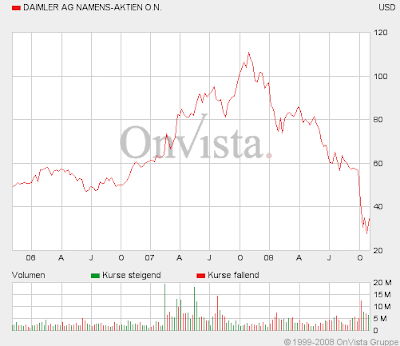
How Daimler Wasted € 7 Billion On Buybacks In Just 15 Months......

Just brilliant! I have nothing more to add that i havn´t already said at the time when the buybacks were introduced ( see Want My Buyback Back ..."Daimler Edition" & I Want My Buyback Back.....Daimler Is Doubling Down Again). All this has happened at a time when Dailmers net liquidity position ( in part due to the buybacks ) has worsened € 9 billion to almost € 46 billion ( see page 28 in Daimler Q3 Presentaion )

Das Daimlermanagement steht dem von diversen Banken in nichts nach...... Ich habe meinen Kommentaren zu diesem Thema zum Zeitpunkt der Rückkaufankündigung ( siehe Want My Buyback Back ..."Daimler Edition" & I Want My Buyback Back.....Daimler Is Doubling Down Again nichts mehr hinzuzufügen..... Hätte nur zu gerne Unrecht gehabt...... Das alles in einer Zeit während sich auch dank der Rückkäufe die Nettoliquidität binnen der letzten 9 Monate um satte 9 Mrd € auf nunmehr knapp 46 Mrd € verschlechtert hat ( siehe Seite 28 der letzten Daimler Q3 Präsentaion )


Daimler
Due to the current uncertainty in the markets Daimler temporarily suspends the further execution of its share buyback program as of October 24, 2008. Due to the suspension Daimler might not reach its initial target to buy back 10% of the outstanding shares.

I hope you can see the impact of the € 7.5 Billion buyback starting in August 2007.......

Der Effekt des Aktienrpückkaufes von € 7,5 Mrd ist klar zu erkennen, oder?


The company started its first share buyback program at the end of August 2007. By March 28, 2008, 99.8 million shares had been bought back for EUR6.2 billion.

Share Buyback based on the Authorization of the 2007 Annual Meeting
Period
No. of Shares Acquired
Average Price (EUR)
Purchased Volume (EUR)
Total
99,768,314
62.11
6,196,752,952.16
March, 2008
27,622,866
53.62
1,481,249,244.31
February 2008
22,185,448
55.69
1,235,524,406.33
December 2007
4,384,000
69.10
302,953,032.70
November 2007
16,366,000
69.05
1,130,005,849.60
October 2007
13,445,000
74.29
998,821,360.14
September 2007
14,390,000
66.72
960,165,710.94
August 2007
1,375,000
64.02
88,033,348.15


In exercise of the authorization granted by the Annual Meeting of April 9, 2008, the decision of the Board of Management allows for the buyback of 10% or approximately 96.4 million of the outstanding shares for a maximum amount of EUR6 billion

Period
No. of Shares Acquired
Average Price (EUR)
Purchased Volume (EUR)
Total
37,283,831
38.86
1,448,922,311.86
Oct 2008
2,283,831
27.88
63,669,232.59
Sep 2008
7,690,000
39.43
303,203,682.07
Aug 2008
6,910,000
40.19
277,696,796.64
Jul 2008
13,850,000
38.14
528,276,120.47
Jun 2008
6,550,000
42.15
276,076,480.09

AddThis Feed Button

Wednesday, October 29, 2008

Counterparty Risk...... Lufthansa Edition

I assume we will hear similar stories for month to come...... We all know that the AIG rescue was mainly because they were a major cds unwriter ( see A Question for A.I.G.: Where Did the Cash Go? ).... After the Lehman collapse and the actions taken from the governments i assume the real danger will come from non bank counterparties ( hedge funds, companies ).......

Ich denke das wir ähnlich gelagerte Geschichten demnächst noch öfter zu hören bekommen.... Die starke Stellung von AIG gerade im Hinblick auf CDS im Zusammenhang mit Banken war der eigentlich Grund für die Rettungsaktion ( siehe A Question for A.I.G.: Where Did the Cash Go? ). Ansonsten hätten alleine europäische Banken zweistellige Mrdbeträge verloren. Nach Lehman haben ja alle politischen Vertreter klar gemacht das es keine Bankenpleiten (Versicherungspleiten ?) mehr geben wird und daher ist davon auszugehen das die nächste Welle der "Counterparty" Risiken sicher von Hedge Fonds und Firmen kommen wird die nicht mehr in der Lage sein werden Ihren Verpflichtungen nachzukommen.....


Bloomberg


Lufthansa's fuel-hedging for the remainder of 2008 fell to 72 percent of needs from 85 percent because the Sept. 15 collapse of Lehman Brothers Holdings Inc. liminated some of the contracts, the airline said. The company, which forecasts fuel expenses will rise 38 percent to 5.4 billion euros this year, is 57 percent hedged for 2009 needs. Spending on fuel next year is targeted at 5.6 billion euros, Gemkow said.

The airline, which took a charge of 76 million euros because of Lehman's failure, doesn't plan to build up its hedging position.

AddThis Feed Button