Wednesday, October 21, 2009

BofA Merrill Lynch Fund Manager Survey Finds Risk Appetite at Highest Point Since April 2006

With almost all asset classes ( Dow 10.100, S&P 500 1100, N100 1780, Dax 5860, FTSE 5250, Oil $ 80 etc ) at new highs it looks like the herd mentality is once more rampant ( fueled in large part from the $ Carry Trade - €/$ 1,50 - & "Quantitive Easing" see also Speaking Of A Money Illusion........ ). Nice to see that after one of the biggest rallies in decades finally the "smart money" ( unlike the retail investor ) is getting more bullish..... As a contrarian it seems lots of folks are "all in"...... Another UPDATE: It remains to be seen if last hour drop from Wednesday was only a minor glitch in the Matrix..... Very telling that this (!!) "bulletproof" strategy seems the only relevant parameter that is important.... until it stops working ....;-) UPDATE: Taking todays ( Oct. 26th ) action into account i think this was more than a minor glitch in the MATRIX... There is now a reasonable chance that this guy will get the upper hand for some time to come..... At least all the "Cash On The Sidelines" ( sarcasm ) has now the opportunity to step in. Add to this that "Wall Street Finest" have only a sell rating on 5 percent of all stocks and the potential for some extra SCHADENFREUDE is not getting smaller.... ;-)

Da gerade heute praktisch alle Vermögenswerte nahe Ihren Jahreshochs ( Dow 10.100, S&P 500 1100, DAX 5860, MDAX 7450, TECDAX 775, FTSE 5250, Öl $ 80 ) notieren ( dank des$ Carry Trades invers zum $ - €/$ 1,50 - versteht sich, sowie dank des sog. "Quantitive Easing" , passend zum Thema Speaking Of A Money Illusion........ ) sieht es in der Tat einmal mehr so aus als wenn der Herdentrieb praktisch alle Marktteilnehmer infiziert hat... Da paßt es gut ins Bild das auch gerade jetzt die Big Boys ( ganz im Gegensatz zu dem Kleinanleger ) nach einer der größten Kursexplosion der letzten Jahrzehnte endlich Ihre Vorsicht über Bord geworfen haben und zum Teil massiv Ihr Risiprofil erhöht haben... Man könnte auch sagen das sie "all in" sind... Erneutes Update: Es bleibt abzuwarten ob der starke Abverkauf in der letzten Handelsstunde vom Dienstag nur ein kleiner Fehler in der Matrix gewesen ist... Wenn man sich aber die anscheinend momentan gängige "Strategie" (!!) ansieht wie die Märkte "funktionieren" sagt das einiges über Robustheit der Rally aus......;-) UPDATE: Nach dem heutigen ( 26. Oktober ) erneuten Abverkauf handelt es sich wohl um mehr als nur einen kleinen Fehler in der Matrix..... Es ist nun nicht unrealistisch das dieser Typ bis auf weiteres die Oberhand gewonnen hat ...... Immerhin ermöglicht dieser noch kleine Rückschlag ja den angeblichem "Cash On The Sidelines" ;- ) sich endlich massivst in den Aktienmarkt einzukaufen.....Wenn man jetzt noch bedenkt das die "Analysten" lediglich 5% der Aktien mit einer Verkaufsempfehlung versehen haben dürfte das die mögliche Schadenfreude nicht gerade mindern..... ;-)


H/T RobotTrader

BofA Merrill Lynch Fund Manager Survey Finds Risk Appetite at Highest Point Since April 2006 as Double-Dip Recession Fears Fade Marketwatch

--Investors See Brighter Corporate Profits on Horizon - Shift from Cash to Equities

Investors' risk appetite has reached its highest point in more than three years amid continued optimism about the prospects for a global economic recovery and rising corporate profits, according to the BofA Merrill Lynch Survey of Fund Managers for October


Investors are increasingly confident that the threat of a double-dip recession is waning. A net 65 percent of respondents believe a global recession is unlikely in the next 12 months, up from 47 percent a month earlier.

A net 72 percent of respondents believe the outlook for corporate profits will improve in the next year, up from 68 percent a month earlier.
The survey also shows asset allocators shifting out of cash and into equities as risk appetite grows. Their cash positions are at their lowest level since January 2004. A net 7 percent of respondents are underweight cash in October, compared to a net 10 percent overweight a month earlier.
A net 38 percent of panelists are overweight equities, up from 27 percent in September. Technology, Energy, Materials and Industrials are the favored sectors for asset allocators in October with investors still shying away from financial
stocks.
Investors seeing value in Europe hits eight-year high

Asset allocators are showing a growing conviction that global corporate profits will post double digit earnings growth, the survey shows. A net 39 percent of panelists think profits will rise by at least 10 percent in the next 12 months, up from just 25 percent in September.

Optimism about Europe is pronounced in the October survey. A net 30 percent of global portfolio managers see eurozone equities as undervalued relative to other regions, the highest reading since April 2001
. A net 9 percent of panelists want to overweight the region in the next 12 months, up from 7 percent last month. This contrasts with Japan, which a net 20 percent of investors regard as the least attractive region a year ahead.

The change in sentiment coincides with a shift in investors' appetite for European financials. Investors are overweight European banks for the first time since June 2007, courtesy of greater confidence in bank balance sheets and profitability trends.

"Europe is emerging phoenix-like from the ashes as confidence in its banks boosts overall confidence in European equities," said Gary Baker, head of European equity strategy at BofA Merrill Lynch Global Research.
> Read this twice...... ;-)
> Das sollte man zur Sicherheit zweimal lesen....... ;-)
Chinese confidence rebounds: U.S. dollar confidence sinks

Confidence in the prospects for the Chinese economy and emerging markets in general remains robust. A net 49 percent of respondents think China's economy will strengthen in the next 12 months, up from 35 percent in September. A net 36 percent of respondents also said they would most like to overweight emerging markets in the next year.

Continuing weakness in the U.S. dollar has resulted in a growing number of respondents who believe the dollar is undervalued. A net 20 percent of panelists regard the currency as undervalued, compared to one percent a month earlier. Japan's economic outlook is marked by a growing number of asset allocators who view the yen as overvalued. A net 34 percent of respondents believe it is overvalued, compared to just 21 percent last month.

"Confidence in Chinese growth has rebounded but worries over a U.S. dollar crisis are on the rise. The dollar is seen as undervalued and the yen as very overvalued, suggesting that central bank intervention in currency markets in coming months could soon prove successful," said Michael Hartnett.

A total of 229 fund managers, managing a total of US$616 billion, participated in the global survey from 2 October to 8 October. A total of 195 managers, managing US$384 billion, participated in the regional surveys.

> It feels like my blog headline "Bubbles Are Normal And Non-Bubble Times Are Depressions...." is the new mantra among central banksters...... ;-)

> Ich fürchte immer mehr das meine Blogüberschrift "Bubbles Are Normal And Non-Bubble Times Are Depressions...." weltweit alle Zentralbankster erfaßt hat....... ;-)

UPDATE:

90% Of Fund Managers Think The Market Will Go Up Clusterstock

Maybe the street has become a bit too bullish afterall.

90% of institutional investors believe that the S&P500 will rise to 1,200 by the end 2011 according to a survey by The Markets. 75% then expect it to hit 1,500 by the end of 2013, and 75% believe that the market already bottomed earlier this year. The survey covered 103 invesors in 20 countries.

We don't necessarily disagree with these views, but naturally find it disturbing to find such a strong consensus on market direction. It sets off our contrarian alarm loud and clear.

The Markets

From Paul Tudor Jones, who reports in his third-quarter letter to investors

While many of our surveys of aggregate hedge fund positioning would say net long exposure has rebounded to late 2007 percentages (though on a smaller base), and mutual fund cash/asset ratios have come in significantly, markets continue to trade as if most are not satisfied with their current commitment to equities.

Fall 2009 Big Money Poll Results Out: Only 13% Are Bearish, 70% Are Beating S&P, As Taxpayers Get Hosed ZH

On economic matters, 72% of respondents believe the recession has ended, and an amusing 52% believe there is no chance of a double dip recession. It is scary that over half of the "sophisticiated community" thinks that Fed can succeed where so many central planning administration have failed before.

Uh-Oh: Economists Say Recovery, Market Gains Solid BR

Nearly four of five economists surveyed by USA TODAY say the stock market rally since March is heralding a sustainable recovery.

> Needless to say that i agree almost 100 percent with this guy & Geremy Grantham....

> Kann nicht oft genug wiederholen das ich zu fast 100% mit diesem Typen & Geremy Grantham übereinstimme.....


JGLetter_ALL_3Q09 -

Wednesday, October 14, 2009

Speaking Of A Money Illusion........

As assumed last Friday the Dow finally hit 10 K. After looking at the chart you probably know why i prefer gold....... I think a few years from now this ratio will be even more favourable.....Wouldn´t surprise me if we see similar ratios like in 1980 . The same is true when you price the S&P 500 in Gold .....

Wie bereits letzten Freitag hat der Dow die 10 K geknackt. Habe das mal zum Anlaß genommen das Dow/Gold upzudaten. Unschwer zu erkennen warum ich seit langer Zeit Gold bevorzuge.... Meiner Meinung nach wird sich dieses Verhältnis zukünftig noch weiter zugunsten von Gold beschleunigen.... Ich würde selbst ein Verhältnis ähnlich dem Jahr 1980 für nicht "unwahrscheinlich" halten. Ähnlich verhält es sich wenn man den S&P 500 in Gold kalkuliert .....

Theodore Weisberg wears a had reading DOW 10,000 after the close of trading on the floor of the New York Stock Exchange in New York.

WSJ

And you thought you had broken even. If investors had bought gold when the Dow first closed above 10000 in March 1999, they'd be up almost 280%.

Put another way, Dow 10000 a decade ago "cost" 36 ounces of gold, treating each Dow point as $1.

When the Dow revisited that level Wednesday, it was worth only 9.276 ounces of gold.

In oil terms, the Dow has gone from 609 barrels to 133.

Chart via Zero Hedge

bigger / größer

Dow 10,000: A Celebration Jesse

Team coverage today on Bloomberg by the Money Honeys as the Dow Jones Industrial Average crossed 10,000 intra-day, led by J.P. Morgan, in a move that surely epitomizes the illusions of wealth granted by modern accounting practices.

Can you believe the NYSE had the nerve to prepare new Dow 10,000 hats and distribute them for today? The first time the Dow Industrials crossed 10,000 was in 1999. The last time it closed over 10,000 was in October of 2008, just
before the most recent plunge of the collapsing credit bubble.

That does not speak well of equities for the "buy and hold" crowd, which has surely had a wild ride if they have indeed managed to hold on for the last ten years, and ex-dividends and fees and commissions and inflation and a plunging US dollar and soaring commodities are... even.
AMEN :-)

UPDATE:

The following videos are too good to be buried in the comment section..... Judging from this interview Bloomberg has morphed into another version of CNBC.......

Denke die folgenden Clips sind zu gut um in den Kommentaren versteckt zu werden..... Muß gestehen das ich nach dem folgenden Interview den Eindruck habe das sich Blommberg und CNBC nicht mehr wesentlich voneinander unterscheiden......


The Colbert ReportMon - Thurs 11:30pm / 10:30c
The Money Shot
http://www.colbertnation.com/
Colbert Report Full EpisodesPolitical HumorMichael Moore


The Daily Show With Jon StewartMon - Thurs 11p / 10c
Dow Jones Rebounds to 1999
http://www.thedailyshow.com/
Daily Show
Full Episodes
Political HumorRon Paul Interview


Tuesday, October 13, 2009

Wall Street Vs Main Street..........

Thanks Ben, Timmy etc....... Yes we can´t........ I think the guy from Main Street ( see Chart of the day, underemployment edition & Still on the Job, but Making Only Half as Much ) will be pleased when he reads this kind of news....... Make sure you watch the Bird & Fortune, FT video: Banking, bonuses, boom and bust :-) & Bank-Favoring Censorship by Congress :-( !

Besten Dank an Ben, Timmy usw........ Yes We Can´t........ Solche "dollen" Nachrichten dürften bei dem Durchschnittsbürger ( siehe Chart of the day, underemployment edition & Still on the Job, but Making Only Half as Much ) besonders gut ankommen..... Die satirische Betrachtung von Bird & Fortune, FT video: Banking, bonuses, boom and bust ist sehenswert und leider recht nahe an der Realität :-)! Wer immer noch Zweifel hat das sich nichts ändern wird sollte dringend Bank-Favoring Censorship by Congress lesen..... DEPRIMIEREND!

[wall_street_bonuses.jpg]

Wall Street On Track To Award Record Pay WSJ

Major U.S. banks and securities firms are on pace to pay their employees about $140 billion this year -- a record high that shows compensation is rebounding despite regulatory scrutiny of Wall Street's pay culture.

Workers at 23 top investment banks, hedge funds, asset managers and stock and commodities exchanges
can expect to earn even more than they did the peak year of 2007, according to an analysis of securities filings for the first half of 2009 and revenue estimates through year-end by The Wall Street Journal.

Total compensation and benefits at the publicly traded firms analyzed by the Journal are on track to increase 20% from last year's $117 billion -- and to top 2007's $130 billion payout. This year, employees at the companies will earn an estimated $143,400 on average, up almost almost $2,000 from 2007 levels.

[Rebound]

H/T Rolfe Winkler

Here is a link to the raw data, below a list of the top 10.

NOTE: This includes only public companies

Blackstone: $4.04 million per employee
Och-Ziff: $878k
Goldman Sachs: $743k
Jeffries: $514k
Lazard: $473k
BlackRock: $318k
Legg Mason: $291k
Eaton Vance: $280k
IntercontinentalExchange: $279k
Morgan Stanley: $263k

Felix Salmon on Goldman

But just because we need these banks to exist does not mean that we want these banks to make enormous profits.....

So the answer to the question Sorkin poses in the question is, essentially, “yes”: we don’t want Goldman to fail, and neither do we want Goldman to reward success in the way it has of late. What we do want is less excess and less systemic risk.

Allowing a super-sized Goldman to pay out untold billions in bonuses every year — even if they’re cleverly structured in the form of slowly-vesting stock — achieves neither of those aims.

Havn´t heard the word "moral hazard" for a long long time.....Unfortunately i think the following excellent cartoon from Gary Varvel is spot on.....

Was ist eigentlich aus dem Wort "Moral Hazard" geworden....... Leider ist der Wahrheitsgehalt des folgenden Cartoons von Gary Varvel erschreckend hoch......

Geithner Aides Reaped Millions Working for Banks, Hedge Funds


Speaking to financial executives last month, Obama said: “We will not go back to the days of reckless behavior and unchecked excess that was at the heart of this crisis, where too many were motivated only by the appetite for quick kills and bloated bonuses.”

At the same time, the president has promised to change Washington by keeping lobbyists for special interests at a distance and by making decisions in the open.

I´ll finish with a good "advice" from Jesse Gold: Until the Banks Are Restrained and Balance Is Restored ... ;-) & a nice rant from Black ( see The financial sector harms the real economy. )

Denke der folgenden Ratschlag Gold: Until the Banks Are Restrained and Balance Is Restored von Jesse & der Standpunkt von Black ( The financial sector harms the real economy. )sind ideal um dieses Posting zu beenden..... ;-)

Update:

JPM Sets Aside $471,779 Run-Rated Compensation For 2009 ZH

Lobbyists Mass to Try to Shape Financial Reform NYT

The financial services industry has poured more than $220 million into lobbying in 2009, much of it in anticipation of this Congressional effort now beginning

Bank Lobbyists Are Not Only Trying to Kill NEW Legislation, They Are Trying to Weaken EXISTING Regulations Washington´s Blog

WALL STREET IS WINNING! Elizabeth Warren "Speechless" About Record Bonuses Blodget

Friday, October 9, 2009

Thank God There Is No Conflict Of Interest....... ;-)

Nothing really new but with the Dow probably hitting 10.000 on Monday i think it´s not a bad time to update the topic "Wall Street Finest" ....... Watch the red line......

Da der Dow wahrscheinlich am Montag die 10.000 knacken wird und auch ansonsten alle Märkte weltweit nahe Ihren Hochs stehen kann es nicht schaden erneut einen Blick die selbstverständlich "höchst wertvolle" Rolle der sog. Experten , oder wie von mir liebevoll als"Wall Street Finest" tituliert, zu werfen..... Man beachte die rote Linie....


‘Sell’ for Research Renegades Becomes Business Off Wall Street
Bloomberg

In October 2008, as the global financial system teetered on the brink of collapse, “sell” calls in U.S. markets constituted 6 percent of the total recommendations by analysts, with “buys” comprising 36 percent and “holds,” 58 percent, according to Bloomberg data.
Almost a year later, amid a stock market rally, the percentage of “buy” calls dropped: They made up 32 percent, with “holds” comprising 63 percent and “sells,” 5 percent, as of Oct. 8.

"Business as usual" ( across all segments ).....Now compare this kind of "wisdom" with the next report on valuations......

"Business As Usual" ( und das über alle Sektoren) ..... Vergleicht bitte die o.g. "Weisheit" mit dem folgenden Report zum Thema Bewertungen......

Special Report Valuation 100909


Mish

Even if one uses "operating earnings" a euphemism for "blatant lie" in which all "one-time losses" that recur like clockwork are ignored (along with everything else the companies want to ignore), the PE based clocks in at 29.64 as of the end of the third quarter according to S&P Earnings Data.

Forward Earnings Imply a Return To Near-Record Profit Margins Hester/Hussman

At these levels it seems that a full-blown V-shaped recovery is being priced in. There's no better example of a V-shaped forecast than for what is expected for the recovery in earnings over the next couple of years. The graph below shows the operating profit series, which includes actual results from the second quarter of 2007 – when earnings peaked – through this year's second quarter, and then continues with estimates through the end of 2011.

For operating earnings to get back to their peak levels, analysts have penciled in earnings growth of more than 40 percent over the next year, and then another 22 percent between 2010 and 2011

What is worth highlighting is that analysts expect that the typical company will soon achieve the same level of profit margin that they were able to deliver in the years leading up to 2007 – a period where leverage was preferred over balance sheet strength, a preference by company managements to focus on equity shareholders, during a political climate where labor lacked bargaining power, where consumer spending was fueled by mortgage equity withdrawals, and leverage ratios increased broadly because business and consumer credit was easy to come by.

To assume a return to peak profit margins is a bet that the economic and political landscape that emerges over the next year or two will match the pre-panic landscape perfectly.

But it is also important to keep this from Barry Ritholtz & Hester in mind......

In jedem Fall sollte man aber diesen Kernsatz von Barry Ritholtz & Hester im Hinterkopf haben.....

Barry: As noted previously, at times, things like “valuation” or the economy or earnings don’t matter — until they suddenly do.

Hester : While S&P earnings may not be able to rise to the lofty expectations of analysts over the next couple of years, this isn't a strongly bearish argument in itself. The link between near-term earnings and stock direction is tenuous. Outside of very large changes in earnings, there is essentially no correlation between year-over-year changes in earnings and changes in stock prices.

But if you're investor that is sensitive to valuation and your preference is to use forward earnings, then an understanding of the building blocks that create those earnings estimates is important.

Regardless of this rule the risk/reward ratio isn´t quite "favourable" ( i´m being polite ) right now...... But as long as the technicals are not breaking down it is still too dangerous to entry a short position...... Even if it is very tempting.... ;-) At least the first not insignificant signs are popping up that the party might be over rather sooner than later......At some point this kind of "wealth transfer" has to stop...... I´m pretty sure this guy will have lots of fun in 2010...... ;-)

Denke es bleibt in jedem Fall festzuhalten das das momentan vorhandene Chance/Risikoverhältnis nicht gerade vorteilhaft ( höflich vormuliert ) ist...... Solange die Markttechnik aber noch intakt ist sollte man auf jeden Fall der Versuchung widerstehen short zu gehen. Auch wenn das tagtäglich schwerer fällt...... ;-) Immerhin sind doch erste ernsthafte Anzeichen zu erkennen die andeuten das der Party bald der Treibstoff ausgeht.......Spätestens wenn diese Art von "Umverteilung notgedrungen Ihr Ende findet......Ich bin mir ziemlich sicher das dieser Typ spätestens im Jahr 2010 eine Menge Spaß haben wird...... ;-)

Quote Of The Day..... "The Defaults Are Worth It "

Looks like i was spot on ....."the Phony Mae & Fraudie Mac pain wasn´t enough......."

Sieht ganz so aus als wenn ich nicht ganz verkehrt gelegen habe......."der Phony Mae & Fraudie Mac Schaden doch noch nicht hoch genug war....... "

A Troubled Portfolio

U.S. Mortgage Backer May Need Bailout, Experts Say NYT

Barney Frank, the Massachusetts Democrat who is chairman of the House Financial Services Committee, said in an interview that the defaults were, in essence, worth it.

“I don’t think it’s a bad thing that the bad loans occurred,” he said. “It was an effort to keep prices from falling too fast. That’s a policy.”

With an insured mortgage exposure already running well over $ 600 billion & spiking higher on a daily basis one has to admit that this clown has CHUZPAH! I suggest to read the entire NYT link.... Lots of stuff that makes a GOLDBUG happy......

Wenn man sich jetzt vor Augen führt das sich die o.g. Institution bereits jetzt für über 600 Mrd $ an wackeligen Hypotheken geradesteht und tagtäglich massivst neue Garantien schreibt muß man diesem Clown zumindest zugestehen das er CHUZPAH hat.....Ich empfehle sich den folgenden Link der NYT komplett durchzulesen.....Läßt das Herz eines GOLDBUGS höher hupfen......

The HYPOCRITE himself in 2005.......


Rolfe Winkler has nailed it a few weeks ago!

Rolfe Winkler hat es bereits vor einigen Wochen treffend formuliert...

"It’s equally likely the agency will continue to be a conduit through which the Obama administration funnels cash to the housing market"

Over $600 billion of loans backed by the end of this year — many very risky due to very low downpayments — but no chief risk officer….
Especially worrysome when the Fed is the only buyer of agency debt right now......

Das ganze wird noch amüsanter wenn man bedenkt das die Fed momentan der einzige Käufer in diesem Marktsegment ist.....

More on this topic

House Hearing on FHA Capital Reserves Home Economics
Bailout watch, US Federal Housing Administration edition FT Alphaville
FHA Bailout Seen Calculated Risk
FHA: Next Bailout? NC
The Sound Of One Hand Clapping Chris Martenson

Tuesday, October 6, 2009

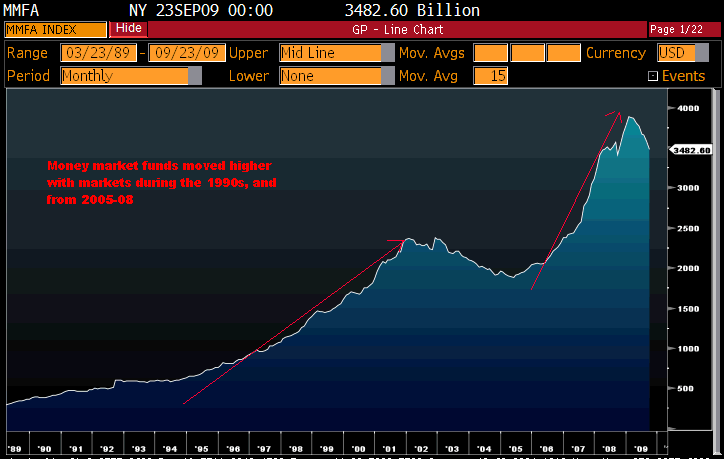
"Cash On The Sidelines" Anti Spin

This quote from James Bianco sums it up ( when it comes to stocks )..... More "Anti Spin" on this topic from Barry Ritholtz, Hussman & Tim Bond

Der nachfolgende Satz von James Bianco trifft es hervorragend ( zumindest wenn es im Hinblick auf Aktien gemacht wird ) .......Mehr "Anti Spin" zu diesem Thema von Barry Ritholtz, Hussman & Tim Bond

“Any time you hear a money manager say there’s $3.5 trillion dollars in cash on the sidelines, take your money away from them. Because he doesn’t know what he’s saying.”


bigger / vergrößerte Version H/T Barry Ritholtz

Will “Cash-on-the-Sidelines” Really Drive Stocks? MarketBeat WSJ
The “cash-on-the-sidelines” argument many market-watchers make to explain why stocks should move still higher shows no signs of losing traction.

MarketBeat: Jim, thanks for taking a few minutes to talk. You recently wrote a research piece saying the assets in money-market mutual funds won’t be moving into stocks anytime soon. How come?

Bianco: If you look at the mutual-fund flows there is a record amount going into bond funds. Forty-two billion dollars went into bond funds in August, which is an all-time monthly record. In fact, the all-time monthly record, I believe, for stock funds was $55 billion back in February of 2000. So it’s pretty close to the stock-fund record. But when you break it down, what you’ll find is that short-term muni funds, and short-term corporate funds, those are the funds that are getting huge, huge inflows.
17216.jpg - 4wk moving avg inflows US bond mutal funds - Bar Cap
The short-term corporate funds are up 12% this year. And as we talk right now, the S&P 500 is up around 16% this year and the Dow is up about 11% this year. That’s including dividends. So my conclusion was, “Yes, there’s a lot of money that’s built up in the cash on the sidelines. Yes, it is going to come out of that zero interest rate funds. And its going into short-term bond funds, which by the way are performing pretty much in line with the stock market. So don’t hold your breath. You’re going to be waiting a long time before you see that money ever matriculate into the stock market.”

MarketBeat: What about the cash-on-the-sidelines argument more broadly. Do you have problems with the fundamental logic of it?

Bianco: Now a couple things about that. The first one is I hate when they say, “There’s $3.5 trillion on the sidelines and that’s a whole lot of money.” It implies that all of that money should be put in investments like the stock market. That’s not true. The vast, vast majority is in transactional balances.

MarketBeat: What does that mean exactly?

Bianco: It’s money that is going to be needed in a very short period of time, like, within a year. It’s going to be spent on something. They’re almost like checking accounts, if you want to think of it that way. It’s like somebody saying, “You’ve got $10,000 dollars in your checking account, why don’t you $10,000 worth of stocks?” And the answer is, “Well because I’ve got to pay my credit card bill and my rent.”

Maybe $1,500, $2,000 or $1,000 of it, I might be able to peel out and put into an investment. But I can’t put the whole $10,000 into it.

MarketBeat: So who owns all this money in money-market funds?

Bianco: The way people say “$3.5 trillion in money-market funds,” they make it sound like $3.5 trillion of widows and orphans are out there irrationally taking a zero-percent return and not recognizing that they should be plowing their money into the stock market.

Well, first of all 65-70% of the money isn’t widows and orphans. It’s institutional money, and the majority of it is transactional balances. So once you stripped all of that out, how much retail money is hiding away from the stock market? The answer is, it’s not very much. It’s probably in the range of a couple of hundred billion dollars.

So there’s a few hundred billion dollars — not $3.5 trillion — that could potentially move back into a longer term investment. My argument is that most of it is already moving. It is moving into short-term bond funds. And those short term bond funds have performed in line with the stock market.

So, what you would need is a massive divergence of those short-term bond funds underperforming — with the stock market not going down — in order to start pushing people out the risk curve even more and into stocks.

So when people say, “Look at all this money. it’s an all-time high in money market funds. And these people are stupid for being in money funds.” Well, money funds have outperformed the stock market for the last 12 years. So shouldn’t money funds have a lot of assets relative to stocks right now? Because we all know that everybody chases performance. So the fact of the matter is there should be a lot of money there because stocks have not performed well. The high-falutin’ technical term for that is “stocks have sucked.”

“Well, they’ve been outperforming cash since March,” would be the argument. Yes, but not over the last two years. People do remember what the stock market did to them last year.

MarketBeat: So, in short you don’t buy the cash-on-the-sidelines argument.

Bianco: No. You know I started in this business in 1986 and there was a ton of cash on the sidelines. And every single day since 1986 everybody has told me that there’s large amounts of cash on the sidelines.

MarketBeat: What do you mean?

Bianco: That’s been a constant argument that’s never gone away. There’s never been a point where anybody has argued that there’s been too little cash on the sidelines. That’s just background noise is all that argument is. Especially when somebody says there’s $3.5 trillion on the sidelines. I was kidding around with some guys in the office here and said, “Any time you hear a money manager say there’s $3.5 trillion dollars in cash on the sidelines, take your money away from them. Because he doesn’t know what he’s saying.”

Equity managers want you to believe that in reality there should be no such thing as a money-market fund. And they should all be closed down and all that money should be put into the stock market.

UPDATE: Quote Rosenberg

"Another way to look at the situation is that when you hear and read about "liquidity" driving the market, it is usually a catch-all phrase for "we have no clue" but it sounds good. "
News from 1930 Daily summary based upon my reading of the Wall Street Journal from the corresponding day in 1930

There's a large amount of money on sidelines waiting for investment opportunities; this should be felt in market when “cheerful sentiment is more firmly intrenched.”
Sounds familar.....? ;-)

Kommt Euch das irgendwie bekannt vor...... ? ;-)

Soured Loans To Other Banks

Just one more example how banks have marked numerous assets on their balance sheets..... ;-)

Ein weiterer Beleg wie marktgerecht die einzelnen Positionen der Bankenbilanzen bewertet sind..... ;-)


WSJ
After slogging through quarters of losses from disastrous bets on the Arizona and Florida housing markets, Milwaukee-based Marshall & IlsleyCorp. is facing a new source of pain: bad loans to other banks.

The bank said Tuesday it expects to post a larger third-quarter loss than analysts had expected, in part because it will set aside $185 million for loans to other banks that have abruptly gone bad.

In fact, the bank said 75% of the now-troubled loans to other lenders were current just seven days ago on Sept. 30.

Here comes another example.......... This time it´s CRE......

Hier ein weiterer Beleg für die "überragende" Bilanzqualität wenn es um die Risikovorsorge bei gewerblichen Immobilien geht.....

Fed Frets About Commercial Real Estate WSJ

In another sign that many U.S. financial institutions are inadequately protected against potential losses on commercial real-estate loans, banks with heavy exposure to such loans set aside just 38 cents in reserves during the second quarter for every $1 in bad loans, according to an analysis of regulatory filings by The Wall Street Journal. That is a sharp decline from $1.58 in reserves for every $1 in bad loans from the beginning of 2007.

[federal reserve and commercial real estate]


Make sure you visit the comment section for another stunning CRE story leading to the highest per-square-foot price paid for a Birmingham office property since 2001, easily topping the 2008 mark........

Empfehle zudem einen Besuch in den Comments für ein weiteres Bespiel aus der "Wunderwelt" der gewerblichen Immobilien die erzählt mit welcher Finanzierung es auch jetzt noch möglich die Quadratmeterpreise aus dem Jahr 2008 locker zu toppen .....