Showing posts with label bubble world tour. Show all posts

Monday, February 22, 2010

Real Estate "Froth" In Hong Kong & China

"Reassuring" that i havn´t read of any new Ghost Towns (at least for today.......UPDATE: I was WRONG....;-) For more on the "China Syndrome" see here, here , here & here.....

Immerhin ( zumindest heute....UPDATE: Zu früh gefreut... ) keine Meldungen über neue Ghost Towns .... ;-) Mehr zum immer ernster werdenden "China Syndrome" gibt es hier, hier , hier & hier.....


Sun Hung Kai sales yield $541 mln over weekend MW
Sun Hung Kai Properties Ltd. (0016.HK) said Monday it sold 900 flats over the weekend at Yoho Midtown, a residential project in New Territories West, for HK$4.2 billion (US$541 million).

The company sold the units at the project in Yuen Long for an average of HK$5,400 per square foot, project director Amy Teo said.

About 40 units were immediately advertised for sale on the secondary market at a premium of up to 20%, the South China Morning Post newspaper reported Monday, citing property agents.

Yoho Midtown is Hong Kong's biggest housing project to go on sale so far this year. It has eight towers containing 1,890 units ranging in size from 400 to 1,400 square feet


China's building bubble about to burst The Star

Frenzied developers with access to cheap money are creating a glut of premium office space and luxury apartments, priced at about 80 times the average income of the city's residents.

Prospective middle-class homeowners, in panic-buying mode, are snapping up two properties at once, hoping to flip the second one to finance the first. Civic officials are encouraging the building boom.

The sale of vacant lots bolster their municipal coffers

The disturbing phenomenon extends beyond Beijing, where housing prices are far higher than in Dubai's overbuilt property market before that red-hot Persian Gulf economy imploded last year. In December alone, Chinese housing prices rose almost 8 per cent in 70 major Chinese cities, while housing starts leapt by 34 per cent nationwide.


China New Village Makes Chanos See Dubai 1,000 Times Bloomberg
The township of Huaxi in the Yangtze River Delta is a proud symbol of how Chinese communists embraced capitalism to lift 300 million people out of poverty during the past three decades.

Its leaders took a farm community with bamboo huts and ox carts in the 1970s and transformed it into an industrial and commercial powerhouse where today many of its 30,000 residents live in mansions and most have a car. Per-capita income of 80,000 yuan ($11,700) -- almost four times the national average -- allows Huaxi to claim it’s China’s richest village.

Huaxi is also emblematic of the country’s construction and real estate boom. Communist Party officials there are building one of the world’s 30 tallest buildings, a 2.5 billion yuan, 328-meter (1,076-foot) tower(Photo Tower ). The revolving restaurant atop the so-called New Village in the Sky offers sweeping views of paddy fields, fish ponds and orchards, Bloomberg Markets reports in its April issue.

Huaxi has an even more ambitious project coming up: a 6 billion yuan, 538-meter skyscraper that would today rank as the world’s second tallest. The only loftier building is the new Burj Khalifa in Dubai.
If the local government in Huaxi really start the "Babel Project" even the biggest "fan" must admit that Beijing has lost control over the provinces....

Sollte der "Tumbau zu Babel" von der lokalen Regierung tatsächlich vorangetrieben werden muß wohl auch der letzte "Bewunderer" eingestehen das Peking schon längere Zeit die Kontrolle über die Provinzfürsten verloren hat.....

UPDATE:

China regulators halt credit to local-government funds MW
China's banking regulator has ordered lenders to stop granting loans to investment vehicles backed by local governments, the latest move to tighten credit standards amid mounting concerns of bad loans down the road, according to a state-media report Wednesday.

Banks have also been ordered to review existing loans used to finance projects backed by local governments, the report said.

Monday, June 29, 2009

Dubai Update.....The Upcoming Skyscraper Tsunami.....

Flashback / Rückblende Feb 2009

In February, Dubai announced a $10 billion bond offering. It was fully subscribed by the central bank of the United Arab Emirates, making it essentially a federal bailout. The Dubai government has used the money to help government-related entities pay off debt.
Dubai is calling the deal between of Emaar with a 100 percent state controlled company a merger.....Good joke...They won´t laugh in Abu Dhabi / UAE for sure.....I´m not sure how long Abu Dhabi ( see also No Kidding.... Dubai May Need Help To Repay Debt...., Dubai's bail-out, Dubai Gets $10 Billion Bailout to Ease Debt , Big spending Dubai may have to be bailed out by Abu Dhabi ) will be "glad" to bail Dubai out..... I assume the next time $ 10 Billion won´t be enough.......

Dubai nennt den Deal zwischen Emaar ( bauen u.a. den modernen Turm zu Babel.... ) und einer anderen Firma die zu 100% im Staatsbesitz zwar eine Fusion. Guter Witz.....In Abu Dhabi / UAE wird man darüber aber wohl kaum lachen ...... Schön zu sehen das der Größenwahn, der nirgends so ausgeprägt gewesen ist wie in Dubai, früher oder später zum scheitern verurteilt ist. Bin gespannt wie lange Abu Dhabi / UAE ( siehe No Kidding.... Dubai May Need Help To Repay Debt.... , Dubai's bail-out, Dubai Gets $10 Billion Bailout to Ease Debt , Big spending Dubai may have to be bailed out by Abu Dhabi ) noch willens ist Dubai mehr oder weniger vor dem Kollaps zu bewahren.... In jedem Fall werden 10 Mrd $ beim nächsten Mal wohl nicht reichen....... UPDATE: ein aktueller Lagebricht von Guido Mingels / Die Zeit Goodbye, Dubai Tip Top!


Dubai Index Drops Most Since November on Emaar’s Merger Plans
June 28 (Bloomberg) -- Emaar Properties PJSC pushed Dubai’s index to its biggest decline in more than seven months on concern shares of the Middle East’s biggest property developer may be suspended or diluted pending a potential merger.

Dubai-based Emaar dropped 10 percent, the maximum daily limit allowed, after the company said it’s in talks to merge with state-controlled Dubai Properties LLC, Sama Dubai LLC and Tatweer LLC, all units of Dubai Holding LLC.
The new entity will have 13.4 billion dirhams ($3.65 billion) in debt obligations, representing 7 percent of total assets, Emaar said today.

“Investors are worried a merger may mean a long share halt as is the case with Amlak and Tamweel,” said Mohamed Dwaikat, a broker at Al Fajer Securities in Abu Dhabi. “There is also concern about a possible dilution of the shares.” Amlak Finance PJSC and Tamweel PJSC, the United Arab Emirates biggest mortgage firms, haven’t traded since November pending a planned merger.

The Dubai Financial Market General Index lost 6.1 percent, the biggest fall since November, to 1,745.07, trimming the gain for this quarter to 11 percent. Abu Dhabi’s ADX General Index retreated 2 percent, paring this year’s advance to 7.7 percent.

Emaar, which is building the world’s tallest tower and makes up about 20 percent of Dubai’s index,fell to 2.89 dirhams.
Al Mal Capital PSC suspended its recommendation on the company, saying the planned merger could be “potentially dilutive” for Emaar shareholders.

Dubai Holding is a 100 percent state-controlled entity, while the government of Dubai owns about a 31 percent stake in Emaar, Bloomberg data show.

> At least Dubai´s sovereign debt rating is better than Iceland´s............

> Dubai schafft es immerhin Island in Scahen Kreditwürdigkeit zu schlagen.......

Sov debt riskiest

> Judging the following project ( see Dubai plans 'moving' skyscraper BBC) i think the term megalomaniac isn´t far-fetched....... I´m pretty sure there is ZERO chance that this "vision" will be build. The following clip is from mid 2008 and clearly a sign how far this bubble has been pumped up....

> Bei Betrachtung der nächsten "Vision" ( siehe Dubai plans 'moving' skyscraper BBC ) ist der Begriff "Größenwahn" sicher nicht zu hoch gegriffen....... Gehe jede Wette ein das dieses Objekt niemals gebaut werden wird. Der nachfolgende Clip ist von Mitte 2008 und zeigt eindrucksvoll welche Aussmaße die Blase zwischenzeitlich angenommen hat.


> Thank god there isn´t a lot of new space coming online .......;-) Now combine the upcoming glut with the sky high price level ( HT Paul Kedrosky )...... DOH! As far as i can see i think not an insignificant amount of the regions SWF will be needed to prop up the banking sector......

> Gottseidank kommt in nächster Zeit ja kaum neues "Material" auf den Markt......;-) Die beste "Medizin" um das bereits jetzt astronomisch hohe Preisniveau ( Dank an Paul Kedrosky ) zu halten..... Denke das ein nicht unwesentlicher Teil der Sovereign Wealth Funds in der Region demnächst benötigt werden um das heimische Bankensystem zu stützen.......

Future Dubai skyscrapers Wikipedia
Under construction Burj Dubai · Pentominium · Burj Al Alam · DAMAC Heights · Princess Tower · Marina 101 · 23 Marina · Emirates Park Towers Hotel & Spa · Elite Residence · Lam Tara Towers · D1 · The Marina Torch · Infinity Tower · Al Yaquob Tower · The Index · HHHR Tower · Ocean Heights · Ahmed Abdul Rahim Al Attar Tower · Central Park Towers · I&M Tower · Dubai Pearl · Sulafa Tower · G-Tower · Mag 218 Tower · Acico Twin Towers · Marina Pinnacle · Khalid Al Attar Tower 2 · Vision Tower · Ubora Commercial Tower · Conrad Dubai · Metro Tower · Al Tayer Tower · Churchill Towers · Sama Tower · The Buildings by Daman · Rolex Tower · Anantara Towers · Tiara United Towers · Al Bateen Tower · Trident Grand Residence · Latifa Tower · Executive Towers · Grosvenor House The Residence · Concorde Tower · Platinum Tower · Dubai Jewel Tower · Jumeirah Bay · Sidra Tower · Dubai Tower · Tiffany Towers · Silver Star · The Bay Gate · Dubai Islamic Bank Tower · Jumeirah Al Khor Residence · Pier 8 · Iris Bay · Liberty House · Goldcrest Executive · Dubai Gate 1 · The Prism · AG Tower · AU Tower · Lake Point Tower · Swiss Tower · Goldcrest Views 2 · The Residences · Silverene · Dubai Arch Tower · Laguna Tower · Verde Residences and Offices

Approved Dubai Towers Dubai · Lighthouse Tower · Al Sharq Tower · The Skyscraper · Al Hekma Tower · Providence Tower · The Palm Trump International Hotel & Tower · Abjar Tower · Nili Tower · ARY Digital Tower · Boraq Tower · The Sheffield Tower · Fortune Araames · Duja Tower · El Matador Tower · Arabian Crowne · Mag 220 Tower · The Dome · Jumeirah Business Center 1 · The Prime Tower · The Forum

Proposed Dubai City Tower · Nakheel Tower · Anara Tower · 1 Park Avenue · Meraas Tower · Marina Sky Towers · Marina 106 · Dynamic Tower · P-17 · The Wave Tower · Signature Towers · His Highness Sheikh Hasher Tower · Beachfront Tower Hotel · Beach Towers · Time Residences · Al Ghaith Tower

> I doubt that even one proposed or approved object will be realized.... Wouldn´t surprise me if we see will something similar what happened in Bangkok ......

> Von den genehmigten bzw. angedachten Projekten wird sicher kaum eines je verwirklicht werden..... Denke es grenzt bereits an ein Wunder wenn die bereits im Bau befindlichen Objekte fertiggesetllt werden.....Könnte leicht passieren das sich ähnliches wie in Bangkok wiederholt......

Monday, February 23, 2009

Beijing's Olympic Building Boom Becomes A Bust

Mish has some similar observations ( see Inside China: A Sculptor's View ) . Lets hope that only a tiny percentage of the recent credit explosion ( see Number Of The Day "Credit Explosion In China" ) will find the way into anything related to real estate........

Da Mish ähnliche Erkenntnisse hat ( siehe Inside China: A Sculptor's View ) dürfte klar sein das nicht nur die wetlichen Banken insolvent sind....... Bleibt zu hoffen das zumindest nur ein kleiner Bruchteil der letzten Kreditexplosion ( siehe Number Of The Day "Credit Explosion In China" ) seinen Weg in den Immobilienmarkt findet......

Beijing's Olympic building boom becomes a bust LA Times
Reporting from Beijing -- "Empty," says Jack Rodman, an expert in distressed real estate, as he points from the window of his 40th-floor office toward a silver-skinned prism rising out of the Beijing skyline.

"Beautiful building, but not a single tenant.

"Completely empty.

"Empty."

So goes the refrain as his finger skips from building to building, each flashier than the next, and few of them more than barely occupied.

Beijing went through a building boom before the 2008 Summer Olympics that filled a staid communist capital with angular architectural feats that grace the covers of glossy design magazines.

Now, six months after the Games ended, the city continues to dazzle by night, with neon and floodlights dancing across the skyline. By day, though, it is obvious that many are "see-through" buildings, to use the term coined during the Texas real estate bust of the 1980s.

By Rodman's calculations, 500 million square feet of commercial real estate has been developed in Beijing since 2006, more than all the office space in Manhattan. And that doesn't include huge projects developed by the government. He says 100 million square feet of office space is vacant -- a 14-year supply if it filled up at the same rate as in the best years, 2004 through '06, when about 7 million square feet a year was leased.
AddThis Feed Button

Monday, October 13, 2008

No Kidding.... Dubai May Need Help To Repay Debt....

I have wondered about Dubai early on in 2007 ( see Dubai / Borrow To Build.....? ) what fundamentals are behind the boom in Dubai. It really looks like lots of the megalomaniac projects that have been anounced and are already under construction will face some serious "headwinds"........ In fairness it has to be mentioned that in 2007 only 7 percent of GDP was oilrelated and lots of the giant projects and investments are an attempt to transfrom the economy... It seems that the pace in recent years was too fast and it feels like an attempt to ramp things up with a crowbar...... SEE UPDATE AT THE END OF THE POST

Ich habe mich bereits in meinen bescheidenen Anfängen als Blogger im Anfang 2007 in Dubai / Borrow To Build.....? gewundert was genau in Dubai abgeht. Es sieht in der Tat so aus als wenn ein guter Teil der größnwahnsinnigen Projekte die angekündigt und die sich fast immer auch schon im Bau befinden in nächster Zeit in erhebliche Probleme laufen könnten...... Müßte lügen wenn ich nicht ein gewisses Maß an Schadenfreude verspüren würde...... Fairerwaise muß man erwähnen das Dubai nur noch 7% des BSP dem Öl zu verdanken hat und die gigantischen Projekte ein Versuch sind die Wirtschaft radikal zu transformieren..... Leider sieht es so aus als wenn hier das Tempo in den letzten Jahren doch erheblich zu hoch gewesen ist und das ganze evtl., doch einem Versuch mit der Brechstange gleicht....... BITTE DAS UPDATE AM ENDE DES POSTINGS BEACHTEN


Oct. 13 (Bloomberg) -- Dubai may depend on support from neighboring Abu Dhabi and the federal government of the United Arab Emirates to help pay for a surge in borrowing, Moody's Investors Service Inc. said.

Government-controlled companies owe at least $47 billion in total, more than Dubai's gross domestic product, according to Moody's data based on economic statistics from 2006.

``We believe that leverage raised primarily through state- owned corporations will continue to grow faster than GDP for at least the next five years, during which time the Emirate's susceptibility toward execution, financing and geopolitical risks will be at its most pronounced,'' Philip Lotter, Dubai- based senior vice president at Moody's, said in a report today.

Dubai has borrowed to fund real estate projects including Burj Dubai, the world's tallest tower, and to buy stakes in Deutsche Bank AG, European Aeronautic Defence and Space Co. and Standard Chartered Plc, as it seeks to reduce dependence on its dwindling oil reserves.

Abu Dhabi, by contrast, owns more than 90 percent of the U.A.E.'s oil reserves and nearly 8 percent of the world's total. The Abu Dhabi Investment Authority, its sovereign wealth fund, has assets of between $250 billion and $875 billion, according to the International Monetary Fund.

Dubai controls its economy through state-owned companies that dominate each major industry. Dubai Holding LLC, which groups assets belonging to Dubai Ruler Sheikh Mohammed bin Rashid al-Maktoum, owns hotel chain Jumeirah Group and Dubai International Capital, which unsuccessfully bid for Liverpool Football Club earlier this year.

Default Swaps
The cost of insuring Dubai Holding's bonds has increased nearly four-fold since May, according to traders of credit default swaps. Contracts protecting Dubai Holding Commercial Operations medium-term notes for four years traded at 679.3 basis points on Oct. 10, up from 172.99 at the beginning of May, CMA Datavision prices show.

Dubai World, a state-owned holding company, acquired almost 10 percent of Kirk Kerkorian's MGM Mirage last year for about $5.1 billion. MGM shares have since tumbled to $16.80 from $84 when the deal was agreed.
> The folling quote is from my post Deutsche Bank Is Doubling Down In Vegas.....

> Der nachfolgende Kommentar stammt aus meinem Post Deutsche Bank Is Doubling Down In Vegas.....

Deutsche will have to raise its bet with another $1 billion investment in the development, at the same time local operator Boyd Gaming has shelved a $5 billion project on the Strip. That looks like a risky double-down for a bank already exposed to MGM Mirage's cash-strapped $11 billion CityCenter project nearby.

> I´m not sure if they are already on the hook but when even Dubai World is late in raising as much as $3.5 billion for their $11.2 billion CityCenter project in Las Vegas it is not a very good sign.....MGM,Dubai Fall Behind on $3.5 Billion Loan for Las Vegas Plan . Watch the folling clip and it is no wonder why they are falling behind..... (clip was deleted.... I wonder why....)

> Ich bin mir nicht sicher ob die Deutsche Bank hier schon im "Feuer" steht. Wenn aber selbst Dubai als Hauptinvestor momentan Probleme hat Kredite zu bekommen ist dies sicher kein gutes Zeichen..... MGM,Dubai Fall Behind on $3.5 Billion Loan for Las Vegas Plan . Schaut Euch den Clip an und es ist wenig verwunderlich warum es Finanzierungsprobleme gibt....... Der Clip ist inzwischen gelöscht worden.... Leicht auszumalen warum.....
Deutsche Bank shares have fallen nearly 70 percent since Dubai government-owned DIFC Investments bought a 2.2 percent stake for about $1.8 billion in May 2007.
``In most countries there are identifiable delineations between the public and private sectors,'' Tristan Cooper, Moody's Middle East sovereign analyst, said in the statement. ``In Dubai, however, the state corporatist model plus the fact that the ruler and his closest relatives form the core of the government, make it difficult to draw such distinctions.''

`Implicit' Support
Abu Dhabi and Dubai are the two-largest emirates in the seven-member U.A.E.

While Dubai's economic model ``has proved successful to date, cumulative liabilities are currently rising faster than investments are able to generate returns, which increases Dubai's medium term susceptibility to execution risks and necessitates a clear understanding of wider implicit federal support when rating key government-backed corporations,'' Lotter said
UPDATE
``We don't have any problem raising money,'' Dubai World Chairman Sultan Bin Sulayem said in a telephone interview in Dubai today.
``Why would we announce a big tower if we can't afford to pay for it?''
> I´ve heard other people saying similar things way too often during the paste few years....
> Den Satz habe ich in den letzten Jahren schon einige Male gehört.......
Dubai's state companies have lost at least $6 billion on their five biggest public investments in the past two years, led by Dubai World's stake in casino operator MGM Mirage. Losses on undisclosed investments may be $30 billion, said Luis Costa, emerging-markets debt strategist at Commerzbank AG in London.

``About 80 percent of Dubai World is non-transparent, so it's a very tough game,'' said Costa. ``Deals such as the world's tallest tower may now need more capital injection from the state or may even fail.''
Ruler Sheikh Mohammed bin Rashid al-Maktoum has borrowed to replace Dubai's dwindling revenue from oil with earnings from tourism, finance and real estate. State-owned carrier Emirates has increased its fleet to the largest in the Middle East and has the most orders worldwide for the Airbus A380 superjumbo, as the government seeks to double tourists per year to 15 million by 2015.

Casino
Dubai World owns DP World Ltd., the third-largest international port operator, Istithmar World, a private equity firm that acquired Barney's New York Inc. last year, and Nakheel PJSC, builder of the manmade palm-shaped islands in the Persian Gulf. The developer is also building the Nakheel Tower, which will surpass the Burj Dubai, currently the world's tallest at 707 meters.
> I´ll bet that this Skyscraper ( see Nakheel Tower / Wikipedia ) won´t be build.... In hindsight Dubai should be grateful that the location had to be changed and the construction hasn´t started yet......
> Ich lehne mich mal aus dem Fenster und behaupte das dieser Turm zu Babel ( siehe Nakheel Tower / Wikipedia ) niemals gebaut werden wird... Im Nachinnein kann Dubai froh sein das sich durch einen veränderten Bauplatz die Konstruktion verzögert hat und der Bau noch nicht begonnen hat.....
Costs are rising on contracts to protect against a default by Dubai Holding LLC, which groups assets belonging to Sheikh Mohammed, including the Jumeirah Group hotel chain. Credit- default swaps rose almost four-fold in the past six months to 684 basis points, the highest in at least four years.

Dubai Holding Commercial Operations Co.'s 10-year bonds due 2017 fell 0.8 percent today, lifting the yield to a record 13.2 percent, Bloomberg data show.

``We are a very solid company and well diversified,'' bin Sulayem said. The notion of Dubai corporations having to rely on Abu Dhabi for funding ``is news to me,'' he said.
2nd. UPDATE
In a report obtained by the Financial Times, the ratings agency says Dubai would lack the financial muscle to cover its debt in the event of a systemic shock, such as a real estate collapse, making it reliant on Abu Dhabi to bail it out.

Publicly recorded debt levels have reached 103 per cent of 2006 GDP, the latest available figure, without including the leverage assumed by aggressive investment companies such as Istithmar and Dubai International Capital.

AddThis Feed Button

Tuesday, July 15, 2008

Spain Bubble & Recession Update

Finally the bursting of the housing bubble has arrived in Spain ( even for the permabulls ) . One of the biggest real estate companies in Spain in going under. Spain is going into a severe recession. Just look at the different charts or watch the clip and everybody with common sense ( doesn´t include economists, "Madrid´s Finest", politicians, management etc) should know that this is going to be very very nasty and not shortlived.......

Wenn einer der größten Immobilienkonzerne Konkurs geht sollte auch dem letzten Daueroptimisten klar sein das die Party vorbei ist. Es ist ausgemachte Sache das Spanien die nächsten Jahre in eine tiefe und langwierige Rezession abgleiten wird. Man braucht nur einen Blick auf die Charts und den Clip zu werfen. Warum diese Entwicklung keiner der "Experten" hat kommen sehen ist schockierend und zeigt einmal mehr das man am besten generell dem gesunden Menschenverstand vertrauen soll. Unabhängig davon was einem täglich von offizieller oder professioneller Seite eingeredet wird. Schließe da auch ausdrücklich alle Medien und sog. Anlegermagazine mit ein.....

When reading the next number it is important to note that France, Germany & UK have a combined population of 200 mio vs 46 Mio in Spain......

Beim Betrachten der nächste Zahl sollte man sich besonders vor Augen halten das Frankreich, Deutschland und England zusammen knapp 200 Mio auf sich vereinen. Spanien hat 46 Mio.....

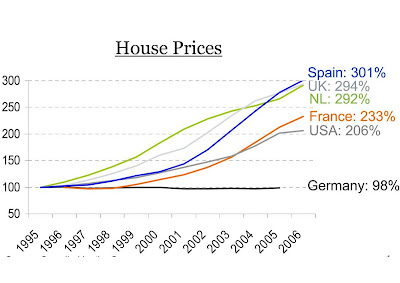
For a decade, the Spanish housing sector enjoyed uninterrupted growth, as low interest rates encouraged borrowing. Average house prices have nearly quadrupled during the past 10 years. About 750,000 homes were built in Spain in 2006 -- more than in France, Germany and the U.K. combined. WSJ

Martinsa asks for creditor protection FT

Martinsa Seeks Bankruptcy Protection After Failing to Get Loan Bloomberg

In Spanien schlägt die Immobilienkrise durch FAZ (inklusive etlicher Charts )

When you now take into account that almost 10 percent of GDP is related to residential housing........

Wenn man jetzt bedenkt das in Spanien ca. 10 des BSP am privaten Wohnungsbau hängen.....

Make sure you watch this clip......

Hier ein reales Beispiel wie sehr die Blase das Leben der "normalen" Menschen bereits jetzt verändert hat.... Möchte nicht wissen wie das Update aussehen würde.....


AddThis Feed Button

Tuesday, February 12, 2008

Irish Property Crashes / Bubble World Tour

Together with Spain & UK Ireland is the posterchild for the housing bubble in Europe. It looks like the next hangover won´t be caused from Guiness.......

Zusammen mit Spanien & UK ist Irland unzweifelhaft die Speerspitze des europäischen Immobilienwahnsinns. Sieht so aus als wenn der nächste Kater nicht vom Guiness kommen wird.....


Global Property Guide The Irish property crash is worsening. Prices paid for second-hand apartments in Dublin fell by as much as 17% in 2007, and house prices in Dublin dropped by an average of 10% on the year, according to a review by the Irish Auctioneers and Valuers Institute (IAVI) (However Sherry Fitzgerald, an agent, reports a more moderate fall of 6.8% in 2007 on second-hand Dublin properties).

In the new apartment market, developers have been giving away cars, bathroom and kitchen suites in a vain effort to hold up prices. That is now starting to crack, as in January, two developers dropped prices 20% on two different developments. .....

Previously, house prices in Ireland had risen further and faster than those of any other country for which figures are reported, except Estonia, having risen for 17 years without a break.

Since 1996, when the surge began in earnest, national house prices rose from €75,000, to €287,664 (end-2006), i.e., a rise of 283% in nominal terms. House prices in Dublin rose even more during the same period, with a 366% rise from €82,400 (1996) to €384,247 (end-2006).


These price rises had one major explanation, the exceptional growth of the Irish economy. In 2006, Ireland experienced 5.6% real GDP growth, and 6.5% real GNP growth. Ireland’s economic growth has been way beyond EU average growth. Ireland experienced average GDP growth of 9.8% during the six years 1995-2000, with no less than 10.7% real GDP growth achieved in 1999, and 11.7% in 1997. Unemployment has fallen from 15% in the early 1990s, to around 4.4% today. There will be an estimated 4.75% GDP growth in 2007, with 3.25% growth forecast for 2008 (Central Bank Bulletin Q4 2007). Inflation is significant, at 4.9% for 2007.

There are two key causes of the slowdown:

Interest rates have risen in tandem with the rest of the Eurozone, moving from 2.25% in December 2005, to 4.0% in June 2007.

Yields across Ireland have averaged 3.1%, according to the most recently bi-annual Daft Report (update expected February). These yields are comparatively speaking very low.

There has also been significant overbuilding. The numbers of dwellings completed has risen very sharply, more than doubling from 30,000 in 1995 to nearly 81,000 in 2005. A third of current housing stock has been built since 1992. During 2007, the stock of houses for sale rose 62%, and transaction volumes fell drastically, according to the most recent Daft report.


The developers have responded, and in 2007 the number of new homes started fell 47% compared with last year. For December, only 925 new homes were registered, down 60% on the same month a year earlier - the lowest monthly figure since records began in 1995.

Gross yields in Dublin are somewhat higher than elsewhere in Ireland, at around 4%. Is this a crisis level?

Readers will know that the Guide gets uncomfortable when yields drop below 5%, significantly uneasy at 4%, and really worried by yields dropping to 3%.

In much of Ireland, current yields levels are at levels which worry us.

True, Ireland is a stable developed country (historical yield figures are unavailable, so it is hard to see whether there has been significant yield compression), its growth and stability justifies somewhat low yields. Central Dublin’s per square meter prices of €3,750 to €5,000 are also high, but arguably not perilously so.

But such low yields make a market very exposed when interest rates rise, especially when the market is largely floating rate. And interest rates have risen – and the market has responded.

Most mortgage loans are variable interest rate (78%). Most fixed-interest mortgages are for periods less than three years (60% of the total). Such high proportions of variable and short-term fixed rates are inherently dangerous.

AddThis Feed Button

Monday, February 11, 2008

ECB To The Rescue....... Bubble World Tour : Spain

No wonder why gold is shining...... I suggest to read ECB A Dumping Ground for Financial Toxic Waste from Lee Adler and especially to watch the video to understand that this kind of collateral is indeed way too often "toxic".....

Kein Wunder das Gold sich trotz zwischenzeitiger $ Stärke weiter gen Norden stürmt..... Ich empfehle zudem noch ECB A Dumping Ground for Financial Toxic Waste von Lee Adler zu lesen sowie zwingend den Clip anzusehen. Sieht so aus als wenn diese Hypotheken zum Teil jetzt bei der EZB lagern......


Spanish banks' reliance on ECB funding surges FT
The European Central Bank has in effect funded new lending in Spain in recent months, replacing banks' use of wholesale capital markets, which have been strangled by the global credit crunch.

Spanish banks doubled their share of the ECB's weekly funding auctions in the final quarter of last year, taking their borrowing up to €44bn ($64bn) in December from a running average of about €20bn over the previous 15 months, according to the most recent data from the Bank of Spain.

This extra lending of almost €24bn outstrips the quarterly amounts raised previously by Spanish banks from securitisation markets, which is an important comparison because the banks have increasingly used mainly mortgage-backed securities as collateral with the ECB.


The market for securitised debt and for mortgage-backed bonds in particular has been almost entirely shut since the credit crunch hit last summer and investors began shunning all kinds of complex, structured debt.

The Spanish banking system is second only to the UK in Europe in its use of mortgage-backed bond markets and other securitisations to fund lending.

However, the Bank of England did not accept mortgage-backed debt as collateral in similar lending operations until after the run on Northern Rock.

Jean-Claude Trichet, president of the ECB, last week insisted the central bank had not been bailing out banks in Spain, but said that there had been a marked increase use of securitised bonds as collateral by Spanish banks and others.

Bank of England lending to UK banks grew by about £6.2bn over the same period, but there is no data on the collateral used. In the US, the Federal Home Loan Bank has pumped $750bn into the system by extending longer-term funding direct to mortgage lenders, such as Countrywide.

The big difference is that European banks must re-raise this funding every week and the mortgage- backed bonds pledged at the ECB eventually will have to find their way to the capital markets, which many analysts believe could mean that markets such as Spain are potentially storing up problems for the future.

While markets for securitised debt remain closed, it is difficult to put a price on European mortgage-backed securities and banks in the region can be much slower to mark down the value of holdings of such bonds. By accepting them in exchange for cash, the ECB may be delaying the repricing of risk that analysts believe is necessary for the orderly resumption markets in such debt.

"The credit markets have been on heroine and while the US solution is put them through cold turkey, the Europeans want to put them on methadone," said one London-based economist.

> Toro has some more thoughts & data on spain

> Toro hat noch weitere Gedanken und Detail zum Thema Spanien

AddThis Feed Button

Thursday, November 29, 2007

UK House Prices Largest Decline since 1995

Crunch, crunch, pop, pop........ No wonder the Bank of England Extends Lending to Relieve `Tight' Money Market . The numbers of loans approved for house purchase are also showing signs of "strss".....For more insight visit the label or the excellent blog from Alice The UK Housing Bubble .

Crunch, crunch, pop pop......Kein Wunder das die Bank of England ernuet "creativ" werden muß Die Anzahl der genehmighten Hypotheken befindet sich wenig überraschend im freien Fall Für mehr zum Thema UK bitte das Label durchforsten oder dem wunderbaren Blog von Alice The UK Housing Bubble einen Besuch abstatten

FT More dismal news for UK homeowners. House prices fell 0.8 per cent in November, according to Nationwide - reining in the annual rate of growth to 6.9 per cent.

That drop is the first since February 2006 - and is the largest decline logged since the summer of 1995.

The figures reverse the unexpectedly strong performance in October - when prices rose 1.1 per cent - but which was widely seen as an aberration in what is a markedly weakening trend for house price data. That’s born out in the three-monthly growth numbers that in the latest period fell back to 1.5 per cent, from 1.8 per cent the month before.

The figures come on the back of dark predictions made through the medium of new derivatives contracts, through which the City is betting on house prices falling 7 per cent next year. The deterioration in outlook reflected in derivs trading, which showed expectations shifting from a 2 per cent fall to a 7 per cent decline in the space of one month, demonstrates how quickly sentiment can shift.

AddThis Feed Button

Wednesday, October 31, 2007

Euroland’s Real Estate and its Importance for the Euroland Economy / Pimco

Matthieu Louanges from Pimco is doing a good job of describing the Eurozone housing market and that there are regions California & Florida would be proud of....... The biggest "froth" is for sure in the UK housing market.

Matthieu Louanges von Pimco gelingt hier wie ich finde eine gute Zusammenfassung des Immobilienmarktes in der Eurozone. Und in der Tat befinden sich einige Länder und Regionen auf Augenhöhe mit Kalifornien & Co....... Für mich der mit Abstand verrückteste Markt ist jedoch nach wie vor der UK Immobilienmarkt.


The bubbles that exist now in housing are in more than two dozen countries.” Alan Greenspan, 2 October 2007

> That´s from the man who once said it is impossible to identify bubbles and especially the US housing bubble and saw a deflation threat with credit growth easy in the double digits....... And that is the same guy that for example, just a year ago, cautiously opined that the “worst [of the housing downturn] may well be over.” Please shut up! Here is what the Case/Shiller futures are predicting for 2011 and the latest news isn´t helping either Foreclosure Filings Soar in 3rd Quarter .......

> Und das vom Mann der noch vor einigen Jahren behauptet hat das es unmöglich ist zu erkennen ob es sich um Blasen handelt. Insbesondere hat er das ganze in den USA nicht kommen sehen. Zudem hat er den Boden für dioe Immobilienkrise für den Herbst 2006 vorhergesagt. Hier ein Blick auf die Housing Futures für das Jahr 2011.Die letzten Meldungen von der Zwangsvollstreckungsfront dürften auch nicht gerade hilfreich sein .... Dafür hat er trotz einem Kreditwachstum was sich bereits im zweistelligen Bereich bewegt hat eine akute Deflationsgefahr erkannt. Das Ende der Geschichte ist bekannt. Schimanski würde wohl sagen "Halt´s Maul!".... :-)

Euroland’s Real Estate and its Importance for the Euroland Economy and ECB Policy

The crisis in the U.S. housing market will – in the view of PIMCO – dominate Fed policy over the next years, and signs for this are already evident. The real estate slowdown has impacted U.S. GDP reports via the negative contribution from the construction sector and we expect that consumption will not escape some significant correction going forward. Will Euroland’s housing market and economy face a similar fate?

Euroland Chasing U.S. Property Prices
More recently, worries about housing markets in other parts of the world have surfaced and with it the fear that the housing slowdown might become a more global phenomenon. The Financial Times of 29 September reported on its front page that “Holiday homes face price fall threat,” stressing the ongoing weakness in the Spanish housing market. As I am French, I am also well placed to report that the doubling of the property prices in France over the last eight years or so has undoubtedly supported consumers’ confidence and their ultimate consumption. I myself enjoyed the wealth effect to some extent (though I don’t own much!) and certainly feel a bit less comfortable now that prices seem to have plateaued and that some house price deflation might seem as unavoidable in my nice city of Les Sables d’Olonne on the French Atlantic coast as in some parts of the United States.

In fact, the real house price appreciation trend in Euroland over the last years has kept up with the U.S. (Chart 1).

How important is and has the real estate market been for the Euroland economy in the last years? Are there signs of weakness yet in the housing market? And, finally, what impact can we expect on consumption and the overall economy, credit growth and European Central Bank (ECB) policy? These are the questions we will address in this piece.

Residential Investment’s Limited Impact
There are different ways through which the real estate market can impact the economy. The obvious one is by looking at the contribution of the construction sector to GDP growth measured by the share of residential investment in GDP as shown in Chart 2. Spain has clearly been benefiting from the boom in the construction sector. The contribution to GDP growth from that part of the economy has been about 1% per year since 1999

In fact, the housing boom in Spain presents some similarities with the post-unification era in Germany, as well as with the most recent developments in the U.S. The share of the construction sector in the Spanish GDP is now higher than it was in Germany at the end of the post-unification real estate boom and much higher than it was at the peak of the U.S. housing cycle in 2005. The impact is less pronounced in other countries.

Looking at France, the contribution of the construction sector to GDP growth has been about 0.2% in the last years while, in Germany, it has even been negative until 2004. Since then, residential investment has stopped being a drag to German GDP growth, which in itself can be seen as a positive.

Transactions and Wealth Effect Drive Consumption
Another way of looking at the importance of the real estate market, particularly housing, is through the consumption effect, which consists of two factors: the number of transactions and the wealth effect. When people buy apartments or houses, they tend to buy more furniture, TVs, etc: This is the transactions effect. When people see the prices of their homes go up, they feel wealthier, have better credit scores and tend to consume more: This is the wealth effect.

From the late 1990s until 2004, both the number of transactions and prices – as shown in Chart 3 – accelerated, especially in France and Spain.

The wealth effect is particularly evident in Chart 4. When we look at 2003 consumption growth in a large group of countries worldwide and regress the growth rate with the level of house price appreciation, we see a strong correlation. Germany and Japan, for example, had no price appreciation and no real consumption growth. On the other hand, Spain and France had strong price appreciation and stronger consumption.

So far, we have seen in this installment of the European Perspectives that since the beginning of this century the share of residential investment has increased in Euroland, particularly in Spain, and that price appreciation in Euroland supported consumption, especially in Spain and France. What we haven’t considered yet is that the boom in housing resulted also in an acceleration of credit growth for home purchases (Chart 5).
We know the ingredients from the finance side that fueled credit growth and thus the housing markets in Europe: low interest rates in the European Monetary Union (EMU) (thanks to the convergence of the national bond curves down to the German yields), innovation in the mortgage markets (with the creation, for example, of new 50-year mortgages) and the exporting of the UK housing bubble into other European regions (through the surge in demand for holiday homes).
We would add that the real estate market tends to act on momentum with increasing prices boosting the demand for real estate as those who are planning a purchase tend to accelerate their decision and as increasing prices make a real estate investment look more attractive for the cohort of pro-cyclical minded investors. On the flip-side, housing slowdowns tend to take a long time to reverse, and this is why the current signs of weakness are particularly alarming.

First Signs of Weakness in Euroland Housing
Currently, there are at least three signs of a weakening in the Euroland housing market: Price appreciation is slowing while mortgage growth and housing permits are indicating a sharp correction in construction activity in the coming months.

Price growth has been slowing for about a year. In France and Spain, the slowdown in price appreciation is remarkable (Chart 3). In fact, the last numbers released by FNAIM (the French federation of real estate agents) indicate some deflation in the French housing market in the last months, with a decline in the prices of apartments of 1.7% over the quarter to September 2007. After multiple rate hikes by the ECB, higher mortgage rates are starting to impact borrowers. In addition, prices have reached levels that made it increasingly difficult for people earning non-investment bank salaries to purchase anything in cities like Paris or Barcelona (the average price per square meter in the centre of Paris is now exceeding 7,000 euros).

Moreover, mortgage growth, as measured by the loans made to households for property purchases, has slowed remarkably since the middle of 2006 (as shown in Chart 5) under the influence of higher mortgage rates, lower affordability and probably a less favorable outlook for housing. What is similarly remarkable – and supports our previous intuition that housing and consumption are well linked – is that consumer credit growth declined simultaneously (Chart 5). The growth rate of credit to households has been slowing overall, which might indicate some weakness to come in Euroland consumption.

This is, of course, an important consideration for the ECB. This development should make the central bank less worried about the pace of credit growth than before, even though broad-based monetary growth remains quite strong due to other factors like the attractiveness of monetary assets in the context of a flat yield curve.

> Too bad that the ECB didn´t care on the escalating way up........

> Nur dumm das die EZB auf dem Weg als die Sache jahrelang eskaliert ist tatenlos zugesehen hat.....

Housing permits in Euroland are now slumping in line with the bearish developments described above. This is particularly the case in Spain, where the number of housing permits is falling by an annualized rate of about 40% (Chart 6). But permits are also falling at the entire euro area level, as the composite shows.

In addition, anecdotal evidence suggests a decline in the number of transactions in countries like Spain and France, but unfortunately, there appears to be no hard data depicting these series (if anybody knows of such a data series, please let me know!).

When summing it up, the story sounds very much like in the U.S. at first sight: Prices are not rising anymore or are even falling, mortgage growth is declining and housing permits indicate a stronger slowdown to come in the contribution of residential investments to GDP growth. However, a Euroland-wide price depreciation does not appear to be a reasonable scenario given the differences between the countries in the euro zone.

Slowing GDP and Credit Growth
The development outlined above suggest that euro area GDP will most likely suffer from negative impacts through construction sector growth as well as deteriorating consumption outlooks in the countries that had enjoyed housing booms. Spain appears particularly at risk, with a GDP growth rate that could fall from a 3.5% pace to 2.5% if the construction sector would stabilize and everything else remained equal (which would not be the case given the negative externalities in terms of consumption as previously noted). France is also at risk but the consumption effect will dominate, based on a decline in the number of transactions, as well as stabilizing, if not falling, prices. From an average of 2.4% household consumption growth per annum, consumption in France has already dropped to a level of 1.7%. However, the countries most affected by the housing and construction slowdown only contribute about 35% to euro area GDP, thus mitigating the impact on the euro zone average. Still, even countries like Germany are experiencing a slowdown in construction, as illustrated by the decline in housing permits.

The good news for the ECB should be the decelerating growth rate in credit to households. Interestingly, in the September ECB press conference, Jean-Claude Trichet spent a long time explaining that several factors are causing broad money growth to rise. He particularly mentioned the flattening of the yield curve, which has increased the attractiveness of monetary assets relative to less liquid, longer-maturity instruments (which should not be too worrisome for the ECB) and the growth of loans to non-financial companies. The recent re-pricing of risks in the credit markets and the ongoing liquidity crisis in Euroland might make these contributions to monetary growth particularly vulnerable in the next months. This should please the ECB.

To sum it up, Euroland enjoyed strong real estate markets over the last years with some similarities to the U.S. when it comes to price appreciation or the contribution of residential investment to GDP growth in some countries. Euroland is now suffering from a significant slowdown in housing, which is most likely going to impact consumption negatively and slow down credit growth to households. In fact, some of these effects are already visible and contributed to the recent downward revisions of GDP growth forecasts for 2008 by most market participants. Ultimately, the housing market developments in Euroland support the case for an ECB on hold for now.

> In the meantime the cpi is climbing to levels we havn´t seen since the ECB is in charge and is sharply higher than their official 2% percent target.... Thank god they are vigilant..... No wonder more and more peoople are daydreamimg how the Bundesbank have handled this mess

> In der Zwischenzeit bewegt sich die Konsumentenpreisinflation auf Höhen die wir seitdem die EZB das Ruder übernommen hat nicht gesehen haben...Zum Glück wird ja täglich betont das sie sehr wachsam sind.......Es wundert mich nicht das sich immer mehr Leute fragen wie eine unabhängige Bundesbank diese Situation gehandhabt hätte.

AddThis Feed Button

Wednesday, October 24, 2007

BOE Says Banks Vulnerable to `Shocks' After Credit Collapse

Looks like the BOE ( and other central banks) will have do to some more bailouts like they did with Northern Rock..... Should be no problem in times when their credibilty is no longer vulnerable ( already gone) .... ;-)

Sieht ganz so aus als wenn die BOE ( und andere Notenbanken weltweit ) zukünftig noch weitere Bailouts wie bei Northern Rock befürchten muß.... Nachdem die Glaubwürdigkeit eh schon arg angekratzt und kaum noch vorhanden dürfte das nicht weiter schwierig werden..... ;-)

BOE Says Banks Vulnerable to `Shocks' After Credit Collapse
Oct. 25 (Bloomberg) -- The Bank of England said the global financial system is at risk of further instability because of ``ongoing uncertainties'' about credit-market losses.

The central bank said in its financial stability report today that markets are now more susceptible to a potential slump in global stocks, a slide in the dollar or a crash in U.K. commercial property after the U.S. subprime mortgage collapse. Merrill Lynch & Co. yesterday reported the biggest quarterly loss in its 93-year history after $8.4 billion of writedowns.


> I highly recommend to read The Role of CDOs in Merrill's Losses (Updated and Expanded Version) from Naked Capitalism

> Kann dazu jedem The Role of CDOs in Merrill's Losses (Updated and Expanded Version) von Naked Capitalism ans Herz legen

``Financial systems in advanced economies are vulnerable to further shocks, either in credit markets or from new sources,'' the Bank of England said in its semiannual report.

Investors are assessing the fallout from a credit-market rout that led to a surge in borrowing costs and a run on the deposits of U.K. mortgage lender Northern Rock Plc. Today's report said British banks are still hoarding cash to protect their balance sheets, which may keep credit conditions ``tight'' into next year and make it harder for some borrowers to manage debt.

While the central bank said ``there have been signs of recovery'' in money markets, the interest rate that banks charge each other for three-month loans hasn't returned to the level before credit costs surged on Aug. 9. The London interbank offered rate, which was 6.05 percent at the start of August, was 6.28 percent yesterday. It touched a nine-year high of 6.9 percent on Sept. 11.

Crisis Management
In a worst-case scenario, U.K. banks would have to raise as much as 170 billion pounds ($348 billion) if market conditions prevented them from selling the loans on their balance sheets to other investors, the central bank said.

The Bank of England, which had been criticized for not doing enough to help lenders after markets seized up, also said U.K. authorities need to ``strengthen their crisis management arrangements.'' Lawmakers will question Chancellor of the Exchequer Alistair Darling on the U.K. government's role in the affair at 11 a.m. in London today.

``Some important lessons need to be learned by both financial institutions and authorities,'' Bank of England Deputy Governor said John Gieve in a statement. His handling of the Northern Rock crisis was singled out for criticism by members of Parliament last month.

Highlighting the risks to global financial stability, the Bank of England said a slump in U.S. economic growth may spark a further drop in ``asset prices'' that ``could trigger a sharp decline in the U.S. dollar.''

> They don´t need to point fingers to the US..... It looks like the debt problem is also spreading to UK corporations...... Easy to figure out what will happen when the economy slows and the credit is less plentyful....

> Hier muß man nicht auf die USA zeigen..... Es sieht so aus als wenn die Kreditprobleme in UK so langsam aber sicher auch die angeblich so soliden Firmenbilanzen betreffen.... Unschwer zu erahnen was passieren wird wenn die Konjunktur ernsthaft ins stocken kommt und die Kreditklemme so richtig zum tragen kommt......
Debt Burden
The U.S. currency has declined 8 percent against the pound in the past year and dropped to a 26-year low of $2.0654 on July 24.

The central bank also said a slowdown in world growth may hurt global stocks and that it's concerned about a potential decline in U.K. commercial property prices.

>LOL! I agree that they should worry about commercial property ( see Commercial property "View from the top" / Economist ). But the far bigger problem is the residential market. Just click here and you will see unlike lots of BOE members the white elefant in the room .....I highly recommend to read Oh no, it can't happen here where Alice Cook from The UK Housing Bubble takes on the view of Kate Barker, who sits on the Bank of England's monetary policy committee..... Looks like the BOE members are as smart as the Fed members....

> Schon lustig.... Ich stimme überein das sich der gewerbliche Immobiliensektor zweifelsfrei jenseits von Gut und Böse bewegt (siehe auch Commercial property "View from the top" / Economist) Aber das eigentliche Problem liegt doch eindeutig im privaten genutzten Immobilienmarkt. Um das auf einen Blick zu erkennen braucht man sich nur diese Daten und Fakten vor Augen zu halten. Ich kann jedem raten sich den nachfolgenden Link durchzulesen.Oh no, it can't happen here . Hier betrachtet Alice Cook vom The UK Housing Bubble was Kate Barker, ein Stimmberechtigtes mitglied des Bank of England's monetary policy committee zu diesem Thema zu sagen hat..... Man fragt sich schon welche Voraussetzungen man erfüllen muß um in diesen Ausschuß zu sitzen.....

The burden on British households, which have taken on a record 1.4 trillion pounds of debt, is increasing along with credit costs, the Bank of England said today. First-time buyers of residential property and investors that purchased homes to rent them out to tenants are ``particularly exposed,'' the report said.

Still, U.K. commercial banks' earnings and their capital reserves have helped them cope with the market rout, the bank said. ``Robust'' economic growth ``and the high profitability and capitalization of major U.K. banks provide a strong anchor for the financial system.''

The report also said the market selloff may be welcome because investors were taking too-optimistic a view on the risks facing the global economy.

``A return to earlier conditions would be undesirable as that involved an underpricing of risk,'' the Bank of England said.

AddThis Feed Button