Showing posts with label Spain. Show all posts

Friday, May 6, 2011

Unemployment rates around the globe

A few weeks ago I posted that Spain's unemployment rate is over 21% and today, the Bureau of Labor Statistics released its monthly report saying "official" US unemployment is at 9%  (its really at 17% but Shhh... Shhh....)

So I was curious to see the most recent unemployment rate figures of other nations.  Because I do not know the interworkings of ever nation's Department of Labor, I can not state if or which nations doctor their numbers as is done in America.  So the following figures are the most accurate information I can provide...

Afghanistan- 35% as of March, 2011; yes 35 out of every 100 unemployed

Australia-  4.9% as of March, 2011-  that's a normal percentage

Austria- 4.8% as of February, 2011

Belgium- 7.6% as of February, 2011

Brazil-  6.5% as of February 2011, and their nation is really growing

Canada-  7.6% as of April, 2011

China- 4.1% as of late 2010; any surprise it will be #1 by 2016

Croatia- 19.3% as of March, 2011;  that's about 1 in 5

Egypt-  9.7% as of early 2011 before Mubarrak left

France-  9.5% as of April 2011; 2010 was 9.1% unemployed

Germany- 6.3% as of February, 2011

India- 10.8% as of early 2011; growing nation with expanding population

Ireland-  14.6% as of May, 2011; 1 in 7 out of work.. other 6 working for IMF

Italy- 8.6% as of January, 2011

Mexico- 5.38% as of February, 2011; with figures like that, you may start seeing 'gringos' rushing over the border for a job

Portugal- 11.2% as of January, 2011

Russia- 7.4% as of February, 2011

South Africa-  25% as of March, 2011; guess the World Cup didn't help

Spain-  21.3% as of April, 2011

United Kingdom-  7.8% as of February, 2011

United States-  9% as of May, 2011;  really 17% when counting the U-6 factors which are conveniently ignored (Kinda like saying only 9% of Americans are redheads by intentionally ignoring the other 8% from your calculations)

Vietnam-  2.9% as of March, 2011; guess that's what happens when a nation makes everything the rest of the world consumes

Zimbabwe- 95% as of early 2011; yes.. 95%.. 9 out of 10 jobless

Friday, April 29, 2011

Random Musings...

I've wondered for some time why people in the US continue to tolerate 'official' unemployment around 9% and unofficial unemployment closer to 17% of the population?   

I guess the answer is if people of other nations peaceably tolerate unemployment of over 21%,we'll tolerate figures that are less so

From CNN:  "Spain's unemployment rate rose nearly a point to 21.29%, with 4.9 million jobless for the first quarter of 2011, the government reported Friday"

________

I've been reading and hearing a lot of pundits declaring re-election victory for President Obama,  a full 19 months before people actually vote..   

Maybe he will win.. maybe he wont..  but here's something to think about:

In 1991, Pres. George Bush, Sr had an Gallop Poll approval rating of 89% after the Persian Gulf War ended

In 1992, Bush's ratings were 29%, due mainly to breaking his pledge of 'Read my lips: No New Taxes' and the nation entering a recession at the time.

This economy has improved only for the financial sector and Wall Street and if you think otherwise, you're watching too much 'American Idol' and 'Glee'.

Moral of story-  When it comes to elections, never assume anything.
_______

Most people believe they know propaganda when they see it- that its something very overt and obvious; that it is exaggerative and forced upon.  While this is true when it comes to advertising products, it is actually extremely subtle when infiltrating news stories.

Here's a example using two headlines from today's Financial Times-- 

1-  Jobless claims spark recovery worries
2-  Growth data cast doubt over US recovery

Innocent looking words that seem straightforward-  but is it?

Let's delve deeper- this is what the headline is saying--

1)  America IS in a Recovery- we and others say it, so its a FACT- ignore your personal economic reality.. everything is getting better children.

2)  Rising jobless claims and weak growth date are problems we can't ignore (though believe us, we'd like to). But instead of acknowledging it as part of an ongoing, never ending recession, we choose to alter the context to fit the more upbeat narrative. A 'negative' has not happened- it is simply a threat of one.  Our advertisers are much pleased...

A different way of explaining this:

You're in a loveless marriage which has been getting progressively worse for 27months. Both you and your spouse are unhappy but he/she wishes to put a happy face on it..  You see it as "irrevocably broken" but your spouse is continually referring to the marriage as an "eventual reconciliation"


Monday, August 23, 2010

Quotes Edward Hugh, John Hussman & Andy Xie

I´m taking a quick break from my "Time-Out".... With "QE 2.0 & 3.0" just around the corner & the € crises off the front pages i think the links are not "unimportant".......

Verabscheide mich nach diesen Posting wieder in die angekündigte "Auszeit".... Im Zusammenhang mit der bevorstehenden "QE Version 2.0, 3.0 usw...." sowie der "fast vergessenen" € Krise erscheinen mir die kompletten Links besonders lesenwert....

Edward Hugh
Spain’s debt for 2010 according to the EDP is expected to reach around 77% of GDP (EU Commission spring forecast), and while we feel it is still possible to agree with the IMF when they say that that “Spain’s (public) debt ratio is low compared with many other countries in Europe”, it is only possible to do so if we do not forget that if we add in the 6% that is held by the Social Security Fund, the 7% that has built up in Accounts Payable and the 5% owed by Spains Public Corporations, we end up with a total of something like 95% debt to GDP, which is, of course, above the average. And this is not to even begin to count all those impending pension liabilities.
John Hussman

My impression is that Ben Bernanke has little sense of the damage he is about to provoke. A central banker who talks about throwing money from helicopters is not only arrogant but foolish.

Nearly a century ago, the great economist Ludwig von Mises observed that massive central bank easing is invariably a form of cowardice that attempts to avoid the need to restructure debt or correct fiscal deficits, avoiding wiser but more difficult choices by instead destroying the value of the currency.

Andy Xie

When the Fed or the European Central Bank tries to stimulate, they are actually stimulating the global economy as a whole. Water, no matter where it comes from, flows downwards. Stimulus, similarly, flows to where costs are low and banking systems are healthy.

If you believe this logic, the actions of the Fed and the ECB fuel inflation and asset bubbles in emerging economies rather than stimulate growth at home.

Lots of damage has already been done...... Regarding "healthy" banking systems China has nothing to worry about... ;-)

Denke das wir bereits heute mehr als genügend Auswirkungen dieser Erkenntnis sehen können.....Immerhin hat China in Sachen "gesunden" Bankensystem nichts zu befürchten.... ;-)

Wednesday, January 27, 2010

BBVA Credit Quality Reality Check.....Spain & Portugal NPA Almost Double To 5.1 Percent

Grim is no overstatement......... Keep in mind that BBVA is probably one of the stronger players ( asset management, south america exposure ) when it comes to the Spanish banking system.....No wonder the "complacency" hit a high just two weeks ago...;-)

Übel ist sicher keine Übertreibung.... Verweise vorsorglich mal darauf hin das BBVA ( Asset Management & Südamerika Diversifikation ) als einer der stärkeren Spieler im spanischen Bankenmarkt gilt....Kein Wunder das weltweit die "Sorglosigkeit" noch vor 2 Wochen neue Hochs erreciht hat.... ;-)

BBVA Q4 Report / PDF
Doubtful risks stood at €15,602m, showing a 24.8% increase over the level reported at 30-Sep-2009.

The NPA ratio rose to 4.3%. This was higher than the third-quarter figure due to the aforementioned increase in doubtful assets. In Spain & Portugal the ratio was 5.1%
cleaner / schärfere Version

The Group’s coverage ratio of 57% at 31-Dec-2009 is considered adequate because if the value of the collateral associated to these risks is included (€16,842m), coverage would increase to 165%......
>Let´s hope their collateral comment has priced in the coming implosion of the Spanish housing market ( so far the market has only fallen slightly UPDATE: This BRILLIANT INTERACTIVE CHART gives an excellent hint that we have almost seen nothing yet )..... Otherwise the coverage ratio would be not quite "prudent"......Keep the following stat in mind....

> Bleibt zu hoffen das hier die jahrelange "Implosion" speziell des spanischen Immobilienmarktes eingepreist ist ( bisher ist der Verfall "moderat" gewesen UPDATE: Dieser brilliante INTERAkTIVE CHART zeigt eindrucksvoll das in Spanien in Sachen Korrektur noch "Nachholbedarf" hat ) ...... Ansonsten wären die vorgenommenen Rückstellungen vorsichtig ausgedrückt nicht gerade "weitsichtig".... Dazu sollte man sich nachfolgende Zahl ins Gedächnis rufen.....

Spain Bubble Watch

For a decade, the Spanish housing sector enjoyed uninterrupted growth, as low interest rates encouraged borrowing. Average house prices have nearly quadrupled during the past 10 years. About 750,000 homes were built in Spain in 2006 -- more than in France, Germany and the U.K. combined.

> Combine the number with unemployment rate hitting almost 20 percent and the picture isn´getting better.....

> Wenn man diese Zahl mit einer Arbeitslosenquote nahe 20% kombiniert dürfte klar sein was sich hier die nächsten Jahre abspielen wird......

UPDATE FT Alphaville

....meanwhile, it seems the group was forced to increase provisions after following through on actual foreclosures and acquisitions. In other words, it wasn’t until the bank acquired the assets that it realised the collateral had been misvalued on its books by €200m. The heart of the problem being the misvaluation of the collateral backing the loans.

>With this kind of accounting it is no wonder BBVA has manage to post a profit......But in comparison to Wells Fargo BBVA isn´t loocking so bad......Banks & balance sheet qualities....... Here we go again.... Nice to see that they are still talking about their "strong" capital ratios & the "nice" dividend ( 30% payout ratio )......

>Bei solch "konservativer" Bilanzierung ist es kein Wunder das BBVA es geschafft hat einen Gewinn auszuweisen....Wells Fargo mußte ganz andere "Verrenkungen" unternehmen ... Nur gut das wir in Sachen Bankenbilanzqualität so große Fortschritte gemacht haben..... Beruhigend zu hören das noch immer von der starken Kapitalausstattung und netten Dividende ( 30& Gewinnausschüttung ) geschwärmt wird....

In Spain & Portugal it ( coverage ratio ) was 48%.

>With over 90 percent of mortgages tied to variable rates they can only pray that the ECB will stay on hold for another decade....

>Da in Spanien über 90% der Hypotheken variabel verzinst sind dürfte dort Stoßgebete in Richtung EZB gehen das die Zinsen noch jahrelang auf dem Tief verharren werden....

>Does anybody remember this "fine tuning" news from Jan. 2009.......

>Erinnert sich noch irgendjemand an die "Fine Tuning" Operation der Banco de Espana vom Januar 2009....

How Not To Restore Confidence....."United Arab Emirates & Spain Edition"

Spanish website Cotizalia reports that Spain’s banks and cajas are negotiating on a one-to-one basis with the Bank of Spain to “fine-tune” their 2008 accounts in order to avoid taking catastrophic write-downs on lans.

According to the article, the central bank has agreed to allow the banks to increase the “calendar of amortisation” of these troubled assets, which are said to be mostly loans to property developers.

>Add the following trade ( couldn´t resist.... ) from the Spanish central bank to the mix and i´ll bet that hand in hand with the banking implosion the so far praised Banco de Espana will face some serious headwinds......

>Bei Begutachtung der o.g. Daten und des nachfolgenden Trades ( konnte nicht widerstehen...) wird eher früher als später vom Glanz der bisher so gelobten spanischen Zentralbank nicht viel übrig bleiben.....

Banco de España has already been delving into the covered bond market with money from gold-sale proceeds FT Alphaville May 2009

Barclays Capital on Wednesday morning cites Spain’s Expansion newspaper on a report that Banco de España has already been delving into the covered bond market with money from gold-sale proceeds .

We note that the latest available data, as reported to the IMF for March, show that Spanish gold holdings at end-March were 9.054mn oz, unchanged since end-July 2007. That said, it should also be noted that Spain slashed its gold holdings during 2005-2008: from 16.826mn oz at end-2004 to 9.054mn in July 2007.

PS: Iberia’s weighting is almost 20% of European GDP & Greece only 3%....

PS: Spanien & Portugal stehen mal eben schlappe 20% des European GDP.... Griechenland für 3%.....

Monday, June 15, 2009

ECB "Instability" Report.......

Not much stability to be found in the ECB Financial Stability Review ( Warning : Over 200 Pages ) ......


Ich konnte wenig Stabilität im 226 Seiten langen EZB Stabilitätsüberblick finden.....

FT


Banks in the 16-nation eurozone face $283bn of further losses this year and next as the recession forces them to write off bad loans, the European Central Bank warned yesterday
> Wishful thinking.....


> Denke das die EZB wie im Regelfall der Musik mal wieder gnadenlos hinterger läuft.... Die Summe würde jeder wohl nur allzu gern für bare Münze nehmen.... Na ja , die EZB erwartet ja auch bereits für 2010 wieder Wachstum.....


The warning, which helped push down the euro against the dollar, came just hours before Moody's, the credit rating agency, downgraded 30 Spanish banks and cajas (unlisted regional savings institutions / see Moody’s bank downgrades, pain in Spain edition & Spanish Banks CDS Ouch!!! via Alea), citing the worsening quality of their loans ( see Chart Of The Day - " 90 Day Delinquency Rates In Spanish RMBS" ) and the struggling Spanish economy.


FT Alphaville


MADRID, June 16 (Reuters) - The number of houses sold in Spain fell by 47.6 percent in April compared to a year earlier, marking the largest percentage fall in 16-straight months of decline, the National Statistics Institute said on Tuesday.

The fates of the eurozone economy and its banks have become increasingly interlinked, the ECB said yesterday in its latest financial stability review report, with bank losses increasingly being caused by bad loans, rather than losses on securities.


Risks to the stability of the financial sector remained high, it said, while "uncertainty prevails" over the banking system's ability to absorb further shocks.


> The exposure to Eastern Europe isn´t "helpful"


> Die extrem starke Stellung in Osteuropa wird die nächsten Jahre ebenfalls wenig hilfreich sein.


Banks' exposure to eastern Europe The Economist


Lucas Papademos, ECB vice-president, said that "a negative interplay" between the financial sector and the economy had become clearer since the start of this year. He stopped short of calling for more transparent stress testing. The ECB, which acts as the monetary authority for the countries that share the euro, is not a bank supervisor.


In spite of the scale of the bank losses forecast by the ECB, its prediction was less gloomy than the International Monetary Fund, which in April put expected writedowns this year and next at $750bn, although taking account of loss provisions and write-offs up until May this year would reduce that to about $540bn.
> I´ll go with the IMF...... Especially in the face of news like this Record Job Losses in Europe via Financial Ninja.... I think it is a safe bet that record job losses will be popping up a a regular basis for years to come....


> Ich bin da eher der Meinung des IMF...... Besonders da wir diese Meldung ( Record Job Losses in Europe via Financial Ninjy ) die nächsten Jahre wohl noch öfter zu hören bekommen werden......


The gap between the ECB and IMF forecasts is due to different assumptions, for instance on the performance of loans.


The ECB also expressed confidence that the eurozone's largest banks could endure any further economic deterioration, saying "most . . appear to be sufficiently well capitalised to withstand severe but plausible downside scenarios".
> Needless to say that i beg to differ...... Taxpayer to the rescue....... This is especially true for the German Landesbanken ( seeGermany's Subprime Crisis: Interview With Achim Dubel & A darkened outlook for Germany’s banks ) The "funny" part is that they were once created to support local economies and are owned by regional governments and savings banks aka the taxpayer.......


> Brauche wohl nicht zu erwähnen das ich diese Meinung nicht teile..... Denke das der Steuerzahler schon bald wieder im großen Stil erneut die Zeche zu zahlen hat ( Bad Banks..... ) Da machen solche Geschichten ( Abstruse Investments der Landesbanken ) gleich doppelt so viel Spaß ....... Passender als Extra 3 ( siehe "Werbespot" der HSH Nordbank ) kann man das Debakel aus deutscher Sicht kaum zusammenfassen ( AusnahmeGermany's Subprime Crisis: Interview With Achim Dubel ) ..... :-)

Tuesday, May 19, 2009

Chart Of The Day - " 90 Day Delinquency Rates In Spanish RMBS"

One or two more quarters and the 2008 vintages are already catching up with 2005....Let´s hope the ECB with their € 60 billion QE in covered bond purchases ( Update : ECB Said to Have Debated 125 Billion-Euro Asset Package in May ) isn´t getting as reckless as the Fed ( for their latest latest stunt see Fed Bends Over Backward For CMSA, Will Feed Inflation Capacitor With More Toxic Garbage via Zero Hedge ) or the spanish central bank with their brilliant move in selling gold to buy spanish mortgages ( see here).....

Noch ein oder zwei Quartale und die 2008er Daten der "überfälligen" Hypothekenzahlungen werden bereits die für das Jahr 2005 locker hinter sich gelassen haben.....Bleibt zu hoffen das die EZB mit Ihrem QE Versuch ( Kauf von € 60 Mrd Covered Bonds / Pfandbriefen UPDATE: ECB Said to Have Debated 125 Billion-Euro Asset Package in May ) zumindest nicht ganz so unverfroren und unverantwortlich agiert wie es die Fed ja momentan im Wochenryhthmus praktiziert ( siehe gestriges Beispiel Fed Bends Over Backward For CMSA, Will Feed Inflation Capacitor With More Toxic Garbage via Zero Hedge ). Wie bereits vorher berichtet ( siehe hier ) übertrumpft die spanische Zentralbank mit der Entscheidung Ihre Goldreserven zu vertickern und dafür in spanische Hypotheken zu investieren aber selbst Bernanke. Und das ist wirklich ne reife Leistung........ Geradezu Oscarverdächtig......

Moody's chart of 90+ day delinquency rates in Spanish RMBS

Hat tip FT Alphaville

With unemployment running close to 20 percent i think it is a safe bet that we are just starting to see the pain ( despite the relief from lower interest payments, almost 100 percent of mortgages have variable rates ( see European Mortgage Market / Percentage Of Variables Rates ) and the Spanish borrower is benefitting heavily from the 1% EZB rate ) But i doubt that this will lead to a much different outcome than in the US ( see A Delinquent Spike / Chart US Delinquencies ) .......

Dank einer Arbeitlslosenquote von knapp 20% dürfte hier demnächst eine Explosion an faulen Krediten fast garantiert sein ( und das trotz der massiven Entlastung durch die sinkenden Zinsbelastungen, im Gegensatz zu Deutschland werden fast 100% der Hypotheken variabel verzinst ( siehe European Mortgage Market / Percentage Of Variables Rates ). Es gibt europaweit wohl kaum eine Kreditnehmergruppe die mehr vom momentanen 1% Leitzins der EZB profitiert , ich denke das selbst dieser Fakt ein ähnliche Entwickluung wie in den USA ( unbedingt den Chart angucken A Delinquent Spike / Chart US Delinquencies ) bestenfalls verlangsamen kann......

UPDATE: Scrutiny of Spain’s potential banking pain increases & Spanish banking pain, Caja Madrid RMBS edition

Caja Madrid - Spain’s second-largest savings bank - said it would skip EUR1.12m in interest payments on residential mortgage-backed securities due to soaring defaults on the underlying home loans.

Caja Madrid issued its RMBS II bonds in 2006....

When defaults reach 18.3 percent, all investors except for those in the highest-ranked notes will be cut off, according to Standard & Poor’s. About 16 percent of the underlying mortgages are now either in arrears by more than 90 days or have already defaulted, S&P data show.

Caja Madrid has sold 9.2 billion euros of mortgage-backed bonds since 2006 in four transactions, according to data compiled by Bloomberg. The lender packaged home loans it made to borrowers at the peak of Spain’s 14-year real-estate boom

Spain Bubble Watch
For a decade, the Spanish housing sector enjoyed uninterrupted growth, as low interest rates encouraged borrowing. Average house prices have nearly quadrupled during the past 10 years. About 750,000 homes were built in Spain in 2006 -- more than in France, Germany and the U.K. combined.

Wednesday, January 28, 2009

How Not To Restore Confidence....."United Arab Emirates & Spain Edition"

So much for the transparancy...... Looks like the prospects for the gulf region reagion are somewhat "clouded"...... This is especially true for the Dubai where the drop height is particularly high..... :-) ( see also No Kidding.... Dubai May Need Help To Repay Debt....)

Einmal mehr zeigt sich das der Ruf nach mehr Transparenz rund um den Globus zu hören ist nicht mehr als Lippenbekenntnisse sind. Schade das man nicht mehr nur explizit auf Fed & Co aus den Staaten schimpfen kann........ Die Aussichten für die noch vor einem Jahr "unverwundbare" Golfregion haben sich nicht nur wegen des fallenden Ölpreises merklich eingetrübt. Zum Glück sind immerhin Teile der Region dank Ihrer Sovereign Wealth Funds nicht von der Gnade ausländischer Kreditgeber abhängig. Dummerweise gilt das nicht für Dubai wo die Fallhöhe besonders hoch ist...... :-) ( siehe auch No Kidding.... Dubai May Need Help To Repay Debt.... )

Hat tip to Tim and his blog The Mess That Greenspan Made

‘Banks are hereby required not to be in a hurry to publish their audited annual accounts’ FT Alphaville

Yes, that’s right.

If you happen to be a bank in the United Arab Emirates you have most likely received the above request from the central bank, according to reports from the Zawya Dow Jones newswire. Could the regional lender of last resort be trying to buy some time? As the agency reports (our emphasis):

DUBAI (Zawya Dow Jones)–The United Arab Emirates’ central bank has sent letters to local lenders asking them not to rush the announcement of their fourth-quarter earnings and to be fair in evaluating their investments, a senior banker said Tuesday. “The central bank sent letters to banks on Saturday to ensure prudent application of disclosure principles.

The central bank asked banks not to rush to announce their results,” the banker, who spoke on condition of anonymity, told Zawya Dow Jones. Under U.A.E. regulations, local banks have a 45-day period from Dec. 31 to report their results. “Banks are hereby required not to be in a hurry to publish their audited annual accounts,” Central Bank Governor Sultan bin Nasser Al Suwaidi said in the letter, seen by Zawya Dow Jones. “It’s a very prudent step to ensure the central bank is able to provide guidance for consistency across all banks in the U.A.E., in particular regarding determination of fair value and on general provisioning such as portfolio level rovisions,” said Sanjay Uppal, chief financial officer at Emirates NBD.

In the letter, the central bank tells bankers that both it and the federal government are aware of the impact the global credit crisis is having on world markets and are addressing the issue of liquidity in the U.A.E., but that banks also have a role to play. “Under these circumstances, banks should exercise vigilance and utmost caution before they publish their audited annual accounts for the year 2008,” Suwaidi said, adding that world markets remain highly volatile as investors have been prone to overreact and as a result securities may be hard to assess. Suwaidi said the central bank has started to examine the “true value” of asset quality in banks. But gauging this may take more time than under normal circumstances, as the central bank needs to identify carefully the nature and value of the assets, Suwaidi said. The central bank also asked financial institutions to build adequate provisions and reserves.


From Creditflux via Alea / FT Alphaville

Spanish website Cotizalia reports that Spain’s banks and cajas are negotiating on a one-to-one basis with the Bank of Spain to “fine-tune” their 2008 accounts in order to avoid taking catastrophic write-downs on lans.According to the article, the central bank has agreed to allow the banks to increase the “calendar of amortisation” of these troubled assets, which are said to be mostly loans to property developers.

AddThis Feed Button

Monday, January 12, 2009

So Begin The (Serious) Sovereign Downgrades…?

A possible downgrade of Spain.......Shocking..... But i doubt we will see some serious action to under AA- ( besides minor countries ) on this front ( just watch the table with regulatory risk weitghtings & the impact on bank´s balance sheets) UPDATE: S&P lowers Greece rating to A- & an excellent Interactive graphic: Europe on credit alert ...... Why numerous countries are still able to get away with an AAA rating is beyond me. Main reason in my mind is the political pressure ( especially when it comes to the US )..... Too bad that countries like Greece, Italy and Spain cannot stimulate their economy with a weak currency like in the past before they joined the €.... It´s a safe bet that the Euro in the current form won´t last ( see also from the FT Could the eurozone actually split up? )? No wonder Gold in € is hitting new highs almost on a daily basis ( see Daily gold price in a range of currencies since January 2000 ) ?


Ein mögliches Downgrade von Spanien.....Schockierend.....Aber ich denke das wir von dieser Seite nichts richtig drastisches auf unter AA- ( abgesehen von einigen unbedeutenden Ländern ) sehen werden ( man braucht dazu nur einen Blick auf die Übersicht mit den risikowichteten Bilanzpositionen zu werfen um zu erkennen welch desaströse Auswirkungen das auf Bankbilanzen hätte ) UPDATE : S&P lowers Greece rating to A- & sowie eine erstklassige Karte der FT Interactive graphic: Europe on credit alert ..... Man muß sich ernsthaft fragen ob die Ratingagenturen überhaupt was aus dem kollosalen Versagen während des Kreditbonanzas gelernt haben..... Wie anders ist es zu erklären das noch etliche Staaten mit AAA bewertet werden? Schon bald peinlich wie noch immer behauptet wird das Ihre "Bewertungen" jenseits von politischen Einflüssen erfolgen ( ist besonders auf die Boni der USA gemünzt )..... Habe noch gut das Hohelied der "Unabhängigkeit" bei den Bewertungspraktiken der implodierten strukturierten Produkten in den Ohren ...... Für Staaten wie Griechenland, Italien, Irland und Spanien ist es natürlich nicht gerade hifreich das Sie sich nicht wie in der Vergangenheit über die Währung etwas Linderung verschaffen können. Ich denke die Aussage das dem € noch turbulente Zeiten ins Haus stehen dürfte untertrieben sein ( siehe auch aus der FT Could the eurozone actually split up? )...... Sicher kein Zufall das Gold in € momentan nahe der historischen Hochs notiert ( siehe Daily gold price in a range of currencies since January 2000 ) .


So begin the (serious) sovereign downgrades…? FT Alphaville

Not just developing world sovereigns either. From S&P today (emphasis ours):


Jan 12 - Standard & Poor’s Ratings Services today said it had placed its ‘AAA’ long-term foreign and local currency sovereign credit ratings on the Kingdom of Spain on CreditWatch with negative implications. A CreditWatch listing signals a potential but not inevitable change in a rating over the short term.


The ‘A-1+’ short-term ratings were affirmed.


“The CreditWatch placement reflects our view of the significant challenges facing the Spanish economy as it traverses a period of very weak growth, and a sustained period of deleveraging, which we expect to lead to a rebalancing toward traded sectors requiring real exchange rate depreciation,” Standard & Poor’s credit analyst Trevor Cullinan said.


In our opinion, the credit-driven nature of Spain’s strong growth performance in recent years has led to a build-up in imbalances, as evidenced by the sizeable current account deficit (around 10% of GDP in 2008).


> For more insights read Why Spain’s Economic Crisis Is Something More Than A “Housing Slump” from A Fistful Of Euros / Edward Hugh. Cleary worth a AAA rating.......


> Deutlich mehr Details bitte Why Spain’s Economic Crisis Is Something More Than A “Housing Slump” von A Fistful Of Euros / Edward Hugh lesen. Klarer AAA Kandidat.......

[spain+income+account.png]

Due to the need for the private sector to restructure and deleverage balance sheets, we believe that the unwinding of the deficit increases the probability of a protracted economic slowdown… Despite a relatively strong starting position, we expect the Kingdom’s public finances to deteriorate markedly, with the general government deficit rising well above 3% of GDP until 2011, and peaking above 6% in 2009.


Now this is only a ratings watch action. No downgrade is necessarily forthcoming. It’s just a distinct possibility.


The spectre of which might go some way as to suggesting why CDS on a triple-A-rated sovereign should be a possibility. Something which has been discussed on FT Alphaville before.


Downgraded securities carry more onerous regulatory risk weightings under the Basel II ratings-based approach:


… unless you have a hedge in place. Such as a sovereign CDS.


That might go some way towards explaining why CDS contracts on Spain are some of the most heavily traded - and have the highest net notional levels - $13,489,091,873 according to the latest DTCC data.

Also up there with Spain: Italy. $158,198,385,126bn gross, $18,283,028,951 net.


If there are downgrades in the Eurozone, there could be some other rather nasty effects.

Country Default Risk Rises Across the Board Bespoke

Ireland, Austria, Greece, and the UK have seen default risk rise the most over the last month. All have risen close to or more than 100%. US default risk has risen the 8th most at 68%.

Countrydefault

> Compare the table above from November 2008 with the latest news from last Friday and it looks like the "market" is once more way ahead of the agencies.....

> Vergleicht man die obrige Tabelle für den November 2008 mit der aktuellen Meldung von letztem Freitag sieht es ganz so aus als wenn die Märkte einen deutlich besseren Indikator als die Ratingagenturen abgeben..... Mal abwarten wann auch hier das Shorting verboten wird........:-)

FT Alphaville

On Friday, Greece and Ireland were also warned by the agency that their ratings could be downgraded as economic conditions worsen

> More evidence example that the market has lost total confidence in the rating agencies....

> Hier ein weiterer Beleg das der Markt zum Glück einiges an Vertrauen in die Methodik der ratingagneturen verloren hat

Credit-Default Swaps on Ireland, Spain Surge on Ratings Threat Bloomberg

Yields on the bonds of smaller European economies, such as Spain, Italy and Greece, have risen to the highest relative to German bunds since before the ECB was established a decade ago. Spanish 10-year notes yield 99 basis points more than bunds, up from 17 basis points one year ago. For Italian notes, the gap almost quadrupled to 141 basis points from 36 basis points.

> Needless to say that the US is of course a rock solid AAA..... For more AAA facts & charts read Deficits, Debt and Looming Disaster: Reform of Entitlement Programs May Be the Only Hope from the St. Louis Fed. I´m with Bill Gross ( see Ponzi meets treasuries bubble ) but am not willing to bet against bonds yet . Here is another very good summary on this topic ( On return-free risk and the bond bubble )It will be fascinating to see what happend to the bondmarket & the $ if the foreigners are finally waking up ( see Who Will Be Left To Buy US Treasuries...... ) I´m still fascinated how the US has manage to finance this ponzi game for years ( NO SARCASM!)....... UPDATE: Another must read via The Mess That Greenspan Made A deflationary spiral?? Not likely in the U.S

> Wie man bei den nachfolgenden Aussichten längerfristig ein AAA der USA rechtfertigen will wissen wohl nur die Ratingagenturen...... Für mehr AAA würdige Fakten und Charts bitte Deficits, Debt and Looming Disaster: Reform of Entitlement Programs May Be the Only Hope der St. Louis Fed lesen. Bin hier klar der Meinung von Bill Gross ( siehe Ponzi meets treasuries bubble ) traue mich aber noch nicht schon jetzt gegen die Bonds zu setzen. Hier kommt eine weiter sehr gute Zusammenfassung zum "Sratus" der US Staatsanleihen (On return-free risk and the bond bubble ) Ein Katalysator für den Shorteinstieg könnte sein wenn die Ausländer die ja den Großteil finanzieren sich aus den Auktionen zurückziehen oder was ja anscheinend keiner auch nur auf dem Radar hat aktiv anfangen Positionen zuverkaufen.Denke dann werden alle von einem "Black Swan" sprechen.( siehe Who Will Be Left To Buy US Treasuries.......) Bis dahin muß man den USA ehrlich Respekt dafür zollen das Sie es bisher geschafft haben Ihre Defizite zu diesen fast beispiellos günstigen Konditionen zu finanzieren. Das meine ich ausnahmsweise mal nicht sarkastisch. UPDATE: Hier noch ein echtes Sahnestück via The Mess That Greenspan Made A deflationary spiral?? Not likely in the U.S

Quote of the Day: S&P is Cool with U.S. Debt HT Infectious Greed

Quote of the day goes to S&P credit analysts for this comment while keeping U.S. credit at a “AAA” rating:

The rating (for the U.S.) was affirmed despite our judgment that fiscal risk has noticeably increased as we expect that the fiscal deterioration will be temporary.

Words to remember

Update / Hat Tip Credit Writedowns

New Zealand’s AA+ Credit Rating May Be Cut, S&P Says -

Bloomberg.com (The article sys “nations that have been downgraded from AAA previously include Japan, Sweden, Finland and Denmark. The rating company today affirmed Australia’s AAA rating.”)

AddThis Feed Button


Tuesday, July 15, 2008

Spain Bubble & Recession Update

Finally the bursting of the housing bubble has arrived in Spain ( even for the permabulls ) . One of the biggest real estate companies in Spain in going under. Spain is going into a severe recession. Just look at the different charts or watch the clip and everybody with common sense ( doesn´t include economists, "Madrid´s Finest", politicians, management etc) should know that this is going to be very very nasty and not shortlived.......

Wenn einer der größten Immobilienkonzerne Konkurs geht sollte auch dem letzten Daueroptimisten klar sein das die Party vorbei ist. Es ist ausgemachte Sache das Spanien die nächsten Jahre in eine tiefe und langwierige Rezession abgleiten wird. Man braucht nur einen Blick auf die Charts und den Clip zu werfen. Warum diese Entwicklung keiner der "Experten" hat kommen sehen ist schockierend und zeigt einmal mehr das man am besten generell dem gesunden Menschenverstand vertrauen soll. Unabhängig davon was einem täglich von offizieller oder professioneller Seite eingeredet wird. Schließe da auch ausdrücklich alle Medien und sog. Anlegermagazine mit ein.....

When reading the next number it is important to note that France, Germany & UK have a combined population of 200 mio vs 46 Mio in Spain......

Beim Betrachten der nächste Zahl sollte man sich besonders vor Augen halten das Frankreich, Deutschland und England zusammen knapp 200 Mio auf sich vereinen. Spanien hat 46 Mio.....

For a decade, the Spanish housing sector enjoyed uninterrupted growth, as low interest rates encouraged borrowing. Average house prices have nearly quadrupled during the past 10 years. About 750,000 homes were built in Spain in 2006 -- more than in France, Germany and the U.K. combined. WSJ

Martinsa asks for creditor protection FT

Martinsa Seeks Bankruptcy Protection After Failing to Get Loan Bloomberg

In Spanien schlägt die Immobilienkrise durch FAZ (inklusive etlicher Charts )

When you now take into account that almost 10 percent of GDP is related to residential housing........

Wenn man jetzt bedenkt das in Spanien ca. 10 des BSP am privaten Wohnungsbau hängen.....

Make sure you watch this clip......

Hier ein reales Beispiel wie sehr die Blase das Leben der "normalen" Menschen bereits jetzt verändert hat.... Möchte nicht wissen wie das Update aussehen würde.....


AddThis Feed Button

Monday, February 11, 2008

ECB To The Rescue....... Bubble World Tour : Spain

No wonder why gold is shining...... I suggest to read ECB A Dumping Ground for Financial Toxic Waste from Lee Adler and especially to watch the video to understand that this kind of collateral is indeed way too often "toxic".....

Kein Wunder das Gold sich trotz zwischenzeitiger $ Stärke weiter gen Norden stürmt..... Ich empfehle zudem noch ECB A Dumping Ground for Financial Toxic Waste von Lee Adler zu lesen sowie zwingend den Clip anzusehen. Sieht so aus als wenn diese Hypotheken zum Teil jetzt bei der EZB lagern......


Spanish banks' reliance on ECB funding surges FT
The European Central Bank has in effect funded new lending in Spain in recent months, replacing banks' use of wholesale capital markets, which have been strangled by the global credit crunch.

Spanish banks doubled their share of the ECB's weekly funding auctions in the final quarter of last year, taking their borrowing up to €44bn ($64bn) in December from a running average of about €20bn over the previous 15 months, according to the most recent data from the Bank of Spain.

This extra lending of almost €24bn outstrips the quarterly amounts raised previously by Spanish banks from securitisation markets, which is an important comparison because the banks have increasingly used mainly mortgage-backed securities as collateral with the ECB.


The market for securitised debt and for mortgage-backed bonds in particular has been almost entirely shut since the credit crunch hit last summer and investors began shunning all kinds of complex, structured debt.

The Spanish banking system is second only to the UK in Europe in its use of mortgage-backed bond markets and other securitisations to fund lending.

However, the Bank of England did not accept mortgage-backed debt as collateral in similar lending operations until after the run on Northern Rock.

Jean-Claude Trichet, president of the ECB, last week insisted the central bank had not been bailing out banks in Spain, but said that there had been a marked increase use of securitised bonds as collateral by Spanish banks and others.

Bank of England lending to UK banks grew by about £6.2bn over the same period, but there is no data on the collateral used. In the US, the Federal Home Loan Bank has pumped $750bn into the system by extending longer-term funding direct to mortgage lenders, such as Countrywide.

The big difference is that European banks must re-raise this funding every week and the mortgage- backed bonds pledged at the ECB eventually will have to find their way to the capital markets, which many analysts believe could mean that markets such as Spain are potentially storing up problems for the future.

While markets for securitised debt remain closed, it is difficult to put a price on European mortgage-backed securities and banks in the region can be much slower to mark down the value of holdings of such bonds. By accepting them in exchange for cash, the ECB may be delaying the repricing of risk that analysts believe is necessary for the orderly resumption markets in such debt.

"The credit markets have been on heroine and while the US solution is put them through cold turkey, the Europeans want to put them on methadone," said one London-based economist.

> Toro has some more thoughts & data on spain

> Toro hat noch weitere Gedanken und Detail zum Thema Spanien

AddThis Feed Button

Wednesday, October 31, 2007

Euroland’s Real Estate and its Importance for the Euroland Economy / Pimco

Matthieu Louanges from Pimco is doing a good job of describing the Eurozone housing market and that there are regions California & Florida would be proud of....... The biggest "froth" is for sure in the UK housing market.

Matthieu Louanges von Pimco gelingt hier wie ich finde eine gute Zusammenfassung des Immobilienmarktes in der Eurozone. Und in der Tat befinden sich einige Länder und Regionen auf Augenhöhe mit Kalifornien & Co....... Für mich der mit Abstand verrückteste Markt ist jedoch nach wie vor der UK Immobilienmarkt.


The bubbles that exist now in housing are in more than two dozen countries.” Alan Greenspan, 2 October 2007

> That´s from the man who once said it is impossible to identify bubbles and especially the US housing bubble and saw a deflation threat with credit growth easy in the double digits....... And that is the same guy that for example, just a year ago, cautiously opined that the “worst [of the housing downturn] may well be over.” Please shut up! Here is what the Case/Shiller futures are predicting for 2011 and the latest news isn´t helping either Foreclosure Filings Soar in 3rd Quarter .......

> Und das vom Mann der noch vor einigen Jahren behauptet hat das es unmöglich ist zu erkennen ob es sich um Blasen handelt. Insbesondere hat er das ganze in den USA nicht kommen sehen. Zudem hat er den Boden für dioe Immobilienkrise für den Herbst 2006 vorhergesagt. Hier ein Blick auf die Housing Futures für das Jahr 2011.Die letzten Meldungen von der Zwangsvollstreckungsfront dürften auch nicht gerade hilfreich sein .... Dafür hat er trotz einem Kreditwachstum was sich bereits im zweistelligen Bereich bewegt hat eine akute Deflationsgefahr erkannt. Das Ende der Geschichte ist bekannt. Schimanski würde wohl sagen "Halt´s Maul!".... :-)

Euroland’s Real Estate and its Importance for the Euroland Economy and ECB Policy

The crisis in the U.S. housing market will – in the view of PIMCO – dominate Fed policy over the next years, and signs for this are already evident. The real estate slowdown has impacted U.S. GDP reports via the negative contribution from the construction sector and we expect that consumption will not escape some significant correction going forward. Will Euroland’s housing market and economy face a similar fate?

Euroland Chasing U.S. Property Prices
More recently, worries about housing markets in other parts of the world have surfaced and with it the fear that the housing slowdown might become a more global phenomenon. The Financial Times of 29 September reported on its front page that “Holiday homes face price fall threat,” stressing the ongoing weakness in the Spanish housing market. As I am French, I am also well placed to report that the doubling of the property prices in France over the last eight years or so has undoubtedly supported consumers’ confidence and their ultimate consumption. I myself enjoyed the wealth effect to some extent (though I don’t own much!) and certainly feel a bit less comfortable now that prices seem to have plateaued and that some house price deflation might seem as unavoidable in my nice city of Les Sables d’Olonne on the French Atlantic coast as in some parts of the United States.

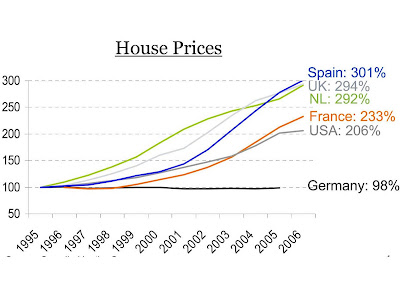
In fact, the real house price appreciation trend in Euroland over the last years has kept up with the U.S. (Chart 1).

How important is and has the real estate market been for the Euroland economy in the last years? Are there signs of weakness yet in the housing market? And, finally, what impact can we expect on consumption and the overall economy, credit growth and European Central Bank (ECB) policy? These are the questions we will address in this piece.

Residential Investment’s Limited Impact
There are different ways through which the real estate market can impact the economy. The obvious one is by looking at the contribution of the construction sector to GDP growth measured by the share of residential investment in GDP as shown in Chart 2. Spain has clearly been benefiting from the boom in the construction sector. The contribution to GDP growth from that part of the economy has been about 1% per year since 1999

In fact, the housing boom in Spain presents some similarities with the post-unification era in Germany, as well as with the most recent developments in the U.S. The share of the construction sector in the Spanish GDP is now higher than it was in Germany at the end of the post-unification real estate boom and much higher than it was at the peak of the U.S. housing cycle in 2005. The impact is less pronounced in other countries.

Looking at France, the contribution of the construction sector to GDP growth has been about 0.2% in the last years while, in Germany, it has even been negative until 2004. Since then, residential investment has stopped being a drag to German GDP growth, which in itself can be seen as a positive.

Transactions and Wealth Effect Drive Consumption
Another way of looking at the importance of the real estate market, particularly housing, is through the consumption effect, which consists of two factors: the number of transactions and the wealth effect. When people buy apartments or houses, they tend to buy more furniture, TVs, etc: This is the transactions effect. When people see the prices of their homes go up, they feel wealthier, have better credit scores and tend to consume more: This is the wealth effect.

From the late 1990s until 2004, both the number of transactions and prices – as shown in Chart 3 – accelerated, especially in France and Spain.

The wealth effect is particularly evident in Chart 4. When we look at 2003 consumption growth in a large group of countries worldwide and regress the growth rate with the level of house price appreciation, we see a strong correlation. Germany and Japan, for example, had no price appreciation and no real consumption growth. On the other hand, Spain and France had strong price appreciation and stronger consumption.

So far, we have seen in this installment of the European Perspectives that since the beginning of this century the share of residential investment has increased in Euroland, particularly in Spain, and that price appreciation in Euroland supported consumption, especially in Spain and France. What we haven’t considered yet is that the boom in housing resulted also in an acceleration of credit growth for home purchases (Chart 5).
We know the ingredients from the finance side that fueled credit growth and thus the housing markets in Europe: low interest rates in the European Monetary Union (EMU) (thanks to the convergence of the national bond curves down to the German yields), innovation in the mortgage markets (with the creation, for example, of new 50-year mortgages) and the exporting of the UK housing bubble into other European regions (through the surge in demand for holiday homes).
We would add that the real estate market tends to act on momentum with increasing prices boosting the demand for real estate as those who are planning a purchase tend to accelerate their decision and as increasing prices make a real estate investment look more attractive for the cohort of pro-cyclical minded investors. On the flip-side, housing slowdowns tend to take a long time to reverse, and this is why the current signs of weakness are particularly alarming.

First Signs of Weakness in Euroland Housing
Currently, there are at least three signs of a weakening in the Euroland housing market: Price appreciation is slowing while mortgage growth and housing permits are indicating a sharp correction in construction activity in the coming months.

Price growth has been slowing for about a year. In France and Spain, the slowdown in price appreciation is remarkable (Chart 3). In fact, the last numbers released by FNAIM (the French federation of real estate agents) indicate some deflation in the French housing market in the last months, with a decline in the prices of apartments of 1.7% over the quarter to September 2007. After multiple rate hikes by the ECB, higher mortgage rates are starting to impact borrowers. In addition, prices have reached levels that made it increasingly difficult for people earning non-investment bank salaries to purchase anything in cities like Paris or Barcelona (the average price per square meter in the centre of Paris is now exceeding 7,000 euros).

Moreover, mortgage growth, as measured by the loans made to households for property purchases, has slowed remarkably since the middle of 2006 (as shown in Chart 5) under the influence of higher mortgage rates, lower affordability and probably a less favorable outlook for housing. What is similarly remarkable – and supports our previous intuition that housing and consumption are well linked – is that consumer credit growth declined simultaneously (Chart 5). The growth rate of credit to households has been slowing overall, which might indicate some weakness to come in Euroland consumption.

This is, of course, an important consideration for the ECB. This development should make the central bank less worried about the pace of credit growth than before, even though broad-based monetary growth remains quite strong due to other factors like the attractiveness of monetary assets in the context of a flat yield curve.

> Too bad that the ECB didn´t care on the escalating way up........

> Nur dumm das die EZB auf dem Weg als die Sache jahrelang eskaliert ist tatenlos zugesehen hat.....

Housing permits in Euroland are now slumping in line with the bearish developments described above. This is particularly the case in Spain, where the number of housing permits is falling by an annualized rate of about 40% (Chart 6). But permits are also falling at the entire euro area level, as the composite shows.

In addition, anecdotal evidence suggests a decline in the number of transactions in countries like Spain and France, but unfortunately, there appears to be no hard data depicting these series (if anybody knows of such a data series, please let me know!).

When summing it up, the story sounds very much like in the U.S. at first sight: Prices are not rising anymore or are even falling, mortgage growth is declining and housing permits indicate a stronger slowdown to come in the contribution of residential investments to GDP growth. However, a Euroland-wide price depreciation does not appear to be a reasonable scenario given the differences between the countries in the euro zone.

Slowing GDP and Credit Growth
The development outlined above suggest that euro area GDP will most likely suffer from negative impacts through construction sector growth as well as deteriorating consumption outlooks in the countries that had enjoyed housing booms. Spain appears particularly at risk, with a GDP growth rate that could fall from a 3.5% pace to 2.5% if the construction sector would stabilize and everything else remained equal (which would not be the case given the negative externalities in terms of consumption as previously noted). France is also at risk but the consumption effect will dominate, based on a decline in the number of transactions, as well as stabilizing, if not falling, prices. From an average of 2.4% household consumption growth per annum, consumption in France has already dropped to a level of 1.7%. However, the countries most affected by the housing and construction slowdown only contribute about 35% to euro area GDP, thus mitigating the impact on the euro zone average. Still, even countries like Germany are experiencing a slowdown in construction, as illustrated by the decline in housing permits.

The good news for the ECB should be the decelerating growth rate in credit to households. Interestingly, in the September ECB press conference, Jean-Claude Trichet spent a long time explaining that several factors are causing broad money growth to rise. He particularly mentioned the flattening of the yield curve, which has increased the attractiveness of monetary assets relative to less liquid, longer-maturity instruments (which should not be too worrisome for the ECB) and the growth of loans to non-financial companies. The recent re-pricing of risks in the credit markets and the ongoing liquidity crisis in Euroland might make these contributions to monetary growth particularly vulnerable in the next months. This should please the ECB.

To sum it up, Euroland enjoyed strong real estate markets over the last years with some similarities to the U.S. when it comes to price appreciation or the contribution of residential investment to GDP growth in some countries. Euroland is now suffering from a significant slowdown in housing, which is most likely going to impact consumption negatively and slow down credit growth to households. In fact, some of these effects are already visible and contributed to the recent downward revisions of GDP growth forecasts for 2008 by most market participants. Ultimately, the housing market developments in Euroland support the case for an ECB on hold for now.

> In the meantime the cpi is climbing to levels we havn´t seen since the ECB is in charge and is sharply higher than their official 2% percent target.... Thank god they are vigilant..... No wonder more and more peoople are daydreamimg how the Bundesbank have handled this mess

> In der Zwischenzeit bewegt sich die Konsumentenpreisinflation auf Höhen die wir seitdem die EZB das Ruder übernommen hat nicht gesehen haben...Zum Glück wird ja täglich betont das sie sehr wachsam sind.......Es wundert mich nicht das sich immer mehr Leute fragen wie eine unabhängige Bundesbank diese Situation gehandhabt hätte.

AddThis Feed Button