Showing posts with label contrary indicator. Show all posts

Wednesday, February 16, 2011

Herding, Risk Appetite & Complacency Somewhat "Elevated".......

Just in time after the fastest 100 percent run of the S&P 500 ever....From a risk/reward standpoint this should at least raise some eyebrows......Especially when you add things like "Rally Intensity", margin pressure, geopolitical "instability", "poor" balance sheet quality, Korean bank runs, "Covenant Lite Flashback 2007, "surreal" trading records, a not so pleasant "Misery Index" ( Unemployment & CPI ), persistant "Buy The Dip" Mentality & an überbullish Biriny into the mix....The term "razor-thin margin of error" is probably not an overstatement..... And i havn´t even mentioned the "almost forgotten" ( sovereign ) debt crises.... I assume the markets will at the latest be "tested" when there are hints that "QE 3.0" will be temporarily off the table......Just as a reminder...QE 2.0 "Run Rate " right now : $3.3 billion per day ($2.3 million every minute) & movements in the Fed’s balance sheet in the last 14 months have had an 86% correlation with the S&P 500 ( David Rosenberg ).... The "Run Rate" number is taken from the latest must read Kyle Bass / Hayman Capital Management investor letter

All das fast auf den Tag genau nach einer Verdopplung des S&P 500....Nebenbei bemerkt im kürzesten jemals gemessenen Zeitraum.....Unter Chance/Risikogesichtspunkten haben die Ergebnisse historisch gesehen eher selten eine "stressfreie" Zeit signalisiert....Wenn man weitere Eckpunkte wie z.B. "Rally Intensität", Margendruck, geopolitische Instabilität, Koreanische "Bank Runs", ultralockere Finanzierungsbedingungen, euphorische Analysten, "surreal" anmutende Handelsergebnisse, einen wenig erfreulichen "Misery Index" ( Arbeitslosigkeit & Konsumentenpreisinflation ), extrem hartnäckige "Buy The Dip" Mentalität & "fragwürdige" Bilanzierungsmethoden zum Gesamtbild hinzufügt, dürfte klar sein, das "das Eis nicht gerade dicker geworden ist"......Das "fast vergessene" Thema (Staats)Schuldenkrise will ich nur am Rande erwähnen...... Die "Widerstandsfähigkeit" dürfte allerspätestens ( dann aber "ernsthaft" ) getestet werden, wenn es erste Signale gibt, das "QE 3.0" zumindest für ein kurzes Zeitfenster nicht auf der Tagesordnung steht.....Man muss sich immer wieder aufs Neue vergegenwärtigen das alleine die FED/Bernanke seit Monaten (und noch bis Juni) im Schnitt umgerechnet tagtäglich $3.3 Mrd ($2.3 Millionen jede Minute ) in die Märkte pumpt & lt. David Rosenberg sich der S&P 500 in den letzten 14 Monaten mit einer Korrelation von satten 86% analog zur Bilanzsumme der US Notenbank entwickelt hat....In diesem Zusammenhang komme ich nicht darum hin auf den wirklich lesenswerten Kyle Bass / Haymann Capital Management Investorenbrief zu verweisen.....Danach dürfte selbst die rosaroteste Brille zumindest einen kleinen Spliss davon getragen haben.....


Net Overweight Equities via FAZ


Raging bulls FT Alphaville
And the overwhelming theme of the latest BofA Merrill Lynch fund managers survey is…

Complacency.

From record equity and commodity overweights…

Asset allocation is straightforward and extreme: equity surges to a record O/W of 67%; commodities also at record O/W of 28%; bond allocation tumbles to -66%, lowest since April’06 and close to a record low.

The February FMS is one of the most bullish in years. Institutions have record equity and commodity overweights, very low cash levels and the strongest risk appetite since Jan‘06.

The FMS Risk Appetite Index rose to its highest level (47) since Jan‘06. Hedge fund net exposure rose to 39%, highest since July’07. Cash balances fell from 3.7% to 3.5%, triggering our FMS cash trading rule equity sell signal

Net Overweight Cash via FAZ


Fondsmanager sind rekordoptimistisch FAZ

Fondsmanager sind äußerst optimistisch. Noch nie hatten so viele von ihnen Aktien in ihren Depots übergewichtet, seit die Frage bei der Umfrage von BofA Merrill Lynch im April des Jahres 2001 zum ersten Mal gestellt wurde.

67 Prozent von ihnen haben Aktien in ihren Depots, so das Ergebnis der Februarausgabe der einmal monatlich stattfindenden Umfrage von BofA Merrill Lynch unter 188 Fondsmanagern weltweit. Das ist der höchste Stand, seit die Frage im April des Jahres 2001 in dieser Form zum ersten Mal gestellt wurde.

Noch im Januar hatte dieser Anteil lediglich 55 Prozent betragen und im Dezember des vergangenen Jahres sogar nur 40 Prozent.

Währen der „Aktienoptimismus“ immer extremer wird, werden die Anleihen immer unbeliebter. 66 Prozent der Fondsmanager haben sie untergewichtet, nach 54 Prozent im Januar und 47 Prozent im Dezember. Die Differenz zwischen jenen, die Aktien über- und Anleihen untergewichtet haben, ist so groß wie noch nie zuvor im Rahmen der Befragung.

Merrill Finds That Money Manager Confidence In Stocks At All Time Record High ZH

Couldn´t resist ( Page 17 )....... ;-)

Kann mir diesen Hinweis ( Seite 17 ) einfach nicht verkneifen..... ;-)

GOLD VALUATION :

FMS respondents remain firmly outside of the GOLD fan club with panellists seeing the metal as overvalued for much of the past 3 years.

February’s reading of net 31% overvalued is little changed from a record reading of a net 33% last month.
Not quite the definition of "ALL IN"..... Reassuring to see that at least since 2008 it seems almost nobody of the so called "Smart Money" has read the Special Gold Report "In Gold We Trust"....

Nicht gerade die Definition von "ALL IN"....... Beruhigend zu sehen das seit 2008 anscheinend immer noch sehr wenige der Fondsmanager einen Blick in den Special Gold Report "In Gold We Trust" geworfen haben....

Sentiment & Herding UPDATE via David Rosenberg ( see Blogroll )
The latest investment surveys show 52% bulls and a mere 13% bears. We heard anecdotally that at the ISI conference, the widespread majority believed new highs were coming for equity valuations, bonds were the most detested asset class, and that inflation was going to rip.

One person who attended told us that he had never before been to an event when the consensus was so one-sided, and that says a lot when you consider all the tech conferences being held in 1999 and 2000.

Reading a Bloomberg news story this morning, we were reminded that you have to go back 40 years to see the last time the U.S. stock market surged as much as it has in the past six months with such little volatility and opportunities to buy on dips along the way. In other words, this is not a normal market by any means,having been a virtual straight line up ever since Mr. Bernanke announced QE2 in late August.

And the same institution that conducted the survey above also just published a report concluding that the Shiller cyclically-adjusted P/E ratio is a relic and not to be relied upon as a valuation tool — perhaps because it is now suggesting that the market is 30% more expensive relative to historical norms.

Share

Friday, June 18, 2010

"Wall Street Finest : It´s Always A Good Time To Buy, Buy, Buy....." BP Edition.....

Even as i have to admit that the "BP SPILL DRAMA" is a very complicated to judge it is nevertheless a perfect fit to my earlier post Wall Street Finest.... Of Course It´s A Good Time To Buy, Buy, Buy..... and a nice confirmation for what i´ve said in the past ....
"There maybe are legitimate reasons to buy stocks, but a favourable opinion from "Wall Street Finest" should definitely not play any role in your screening process .... Except you use them as a "contrary indicator".... ;-) "
Selbst wenn ich zugeben muß das der BP GAU schwer einzuschätzen ist, passt es wie die Faust aufs Auge zu Wall Street Finest.... Of Course It´s A Good Time To Buy, Buy, Buy..... und ist nebenbei die Bestätigung zu dem was ich bereits seit langem zum Thema "Experten" zu sagen habe....
"Grundsätzlich mag es ja durchaus gute Gründe die für Aktien sprechen geben, man sollte aber sicherstellen das die Einschätzungen der "Experten" beim Auswahlprozess keinerlei Rolle spielen....Es sei denn man nutzt sie als Kontraindikator.... ;-)"

Special Report: Amid the Gulf crisis, Wall St touted BP stock Reuters

As early word of BP's Deepwater Horizon blowout began spreading, investors panicked. After closing above $60 before the April 20 disaster, the energy giant's shares plunged almost 20 percent in New York, to below $50, in just two weeks.

It is not hard to understand why. Even then, the out-of-control oil spill in the midst of rich fishing grounds and nearby resort beaches raised the specter of horrific damages and untold potential liabilities.

Yet, nearly to a person, the dozens of securities analysts who followed the British oil giant were unfazed. As BP shares continued to drop, most were screaming the same message: buy, baby, buy.

Credit Suisse, which had a "buy" rating on the stock at the time, did not even mention the accident in an April 28 report. The firm upgraded earnings estimates after BP reported strong quarterly results the day before.

A day later, with BP's shares then down 11 percent, Citigroup's Mark Fletcher weighed in. He argued that the decline was "disproportionate to the likely costs to the company, even assuming damages can be claimed." In the same report, he estimated BP's total share of the cleanup at just $450 million -- today, conservative guesses put the figure at $10 billion to $20 billion.

Around that time, Morgan Stanley was among the chorus citing the strong rebound of Exxon (XOM.N) shares after the 1989 Valdez tanker spill in Prince William Sound, Alaska, as a reason to be bullish. "We think the sell-off presents an attractive buying opportunity for investors with medium-term investment horizons," the firm wrote.

All told, 27 of 34 analysts tracked by Thomson Reuters rated the stock "buy" or "outperform" as recently as May 11. The other seven rated the shares "hold." There was not a single rating of "sell" or "underperform" among those tracked.

And then there was the exuberant television host Jim Cramer, who insisted that Bear Stearns was fine just days before the company's stock crashed. On May 10, he told viewers of his "Mad Money" (Cramer: "The Dividend Is Safe, Way Overdone On The Downside" / Stock just under $ 50 & Cramer:Gulf Spill Won’t Break BP / Stock above $ 50 ) show on CNBC that he was purchasing shares of BP for his charitable trust at just under $50. "If you get any good news at all, you're at the bottom," he said. "I'd like to buy it.

BP has at least managed to outperform his May 10th "Housing Shortage Top Pick" SPF... I doubt that he is still refering to his Housing Shortgage Play Version 1.0 July 2008 and has meanwhile switched to version 2.0 or 3.0....To be continued.....UPDATE: Watch his comments after the entire group has tumbled close to 30% & his top pick SPF worst.... To call him a revisionist is an understatement.... Couldn´t resist.....

Immerhin hat BP es geschafft besser als sein anderer Favorit SPF abzuschneiden....Nach seinen letzten Kommentaren im Angesicht einen 30% Crashes im Homebuildingsektor sowie einer Halbierung seines Favoriten SPF muß man schon sagen das der CHUZPAH mehr als treffend ist....


If he did, he didn't make out so well. As estimates of the spill grew -- and grew and grew -- and efforts to cap it failed, BP's stock sunk ever lower. It didn't hit bottom for another month, the New York-traded ADRs touching $29 in midday trading on June 9, down 52 percent from just before the Deepwater Horizon disaster. That's approaching $100 billion in shareholder wealth that has been destroyed.

GROUP THINK

Others say the failure of even one analyst at a major firm to grasp the potential risks and advise clients to dump the stock reflects the profession's overall group-think tendencies. "For sell-side analysts, the incentive is to remain toward the center of the pack. If they are going to be wrong, they have got to be in good company," said Michael MacPhee, at investment manager Baillie Gifford.

As the shares headed toward almost half their pre-disaster level, most analysts issued more cautious notes, with Goldman, Natixis, S&P equity research and Charles Stanley, cutting their ratings to neutral or hold from buy.

By June 16, BP was rated a buy by 16 analysts, outperform by eight, a hold by another 8 with only one sell, according to data on Reuters Knowledge. That was the date, of course, when BP agreed to fund a $20 billion escrow account and suspend its dividends for the year.

With the price around half what it was before the spill, analysts might have a stronger argument that BP was a buy in mid-June, though that will be of little comfort to anybody who followed the advice to buy a month ago.

H/T Reformed Broker

Bloomberg

The split over BP between U.K. and U.S. investors extends to analysts. The U.K. stock has 26 “buy” recommendations, while 12 analysts recommend holding the stock and two say to sell. In contrast, almost as many U.S. analysts advise against purchasing the stock as buying it. The ADRs have seven “buy” recommendations, five “holds” and one “sell.”

And when a guy like Chanos is shorting Exxon widely viewed as the goldstandart in the industry you have to wonder even more....

Wenn ein Typ wie Chanos momentan aber selbst den am meist angesehenen Titel im Sektor Exxon shortet ist das zumindest mehr als eine Randnotitz wert.....

Watch the percentage of sell ratings for S&P 500 companies flatlining even in the deepest recession since 1930........

Man beachte die rote Linie der Verkaufsempfehlungen für die 500 Unternehmen im S&P die selbst während der tiefsten Rezession seit 1930 "stabil" geblieben ist......

BP Oil Spill: Brief History of The Incredible Rising Cost Estimate WSJ Marketbeat

BofA Merrill, April 28 — “To put it in context, the Valdez clean-up cost reportedly reached [around] U.S. $3 billion and we expect the cost to BP to be lower at this point.”

BofA Merrill, April 30 — “If we assume the clean-up takes 6 months and include relief wells costs, total costs would be in the U.S. $2 billion range (U.S. $100 million per well + 180 days at $10 million/day). Even assuming additional civil damages similar to Exxon Valdez of US$2.5 [billion] awarded against [Exxon Mobil] in 2009, BP’s net costs for Macondo would approach [$3 billion] – just over half [first quarter 2010] earnings. While the market may not be willing to assume such a scenario, given ongoing uncertainty, it, nevertheless, underscores that the hit on BP’s shares looks overdone.”

BofA Merrill, May 28 — “The US Geological Survey (USGS) has independently estimated that the flow rate at Macondo is in the 12-19kb/d range. Whilst this is clearly larger than the previous [5,000 barrels a day range] estimate, it is inline with the flowrates of typical wells in the area as we had indicated (see BP: Making tangible progress 21-May). We note that this new information makes no difference to our worst case liability estimate of U.S. $10 [billion] – based on the recently proposed liability limit.”

BofA Merrill, June 10 — “Given the uncertainties presented by the spill (our base case cost est. is $28 [billion] but the worst case scenario cannot be adequately quantified.”

To be continued.....Check out the link for more stunning quotes.... Let´s all hope we won´t see an updated "Hurricane Edition".....

Fortsetzung folgt.......Mehr von den "Experten" gibt es hier.... Daumen drücken das wir um eine ähnliche Auflistung im Zusammenhang mit der "Hurricane Saison" herumkommen.....

Wednesday, March 10, 2010

Cramer´s Bull Case For Banks..... I Can Smell A Top... ;-)

Oh boy..... After the ( even by his standarts.... ) famous "Housing & Bank Stock Shortage" call from January 2008 ( NO KIDDING > see "Ten Trillion $ Worth Of Good Calls" ) was a little bit "premature" he is predicting a bank stock shortage version 2.0.... Would at least be honest if he mentioned the "ultimate moral hazard trade" & the "Enron-esque characteristics" when it comes to accounting as the two main reasons behind the motives to own banks.. ;-)

Die Euphorie ist zurück........ Nachdem derselbe Typ Januar 2008 leicht "verfrüht" bereits einmal eine "Housing & Bank Stock Shortage" ( siehe "Ten Trillion $ Worth Of Good Calls") proklamiert hat ist es höchtse Zeit für eine Version 2.0.....Wäre zumindest ehrlich gewesen wenn er in seinen 10 Gründen die unbedingt dafür sprechen sofort massiv Bankaktien zu kaufen den "ultimativen Moral Hazard Trade" sowie die kreative Bilanzierung die stark "Enron-esque characteristics" aufweist als die Topgründe aufführen würde.... ;-)


Just for the record here are the two main ETF´s tracking the financial sector.....

Nur um die Daten festzuhalten nachfolgend die beiden relevanten Bank/Finanz EFT´s....

Financial Select Sector ETF) $ 15,47 & KBW Regional Banking (ETF) $ 25,47

Needless to say that both ( along with almost every asset class worldwide ) are trading at 52 week highs & had the longest winning streaks since 1995.....Especially Citigroup seems to be a "real bargain"... ;-)

Überflüssig zu erwähnen das die EFT´s ( wie fast alle anderen Anlageklassen weltweit ) auf Jahreshochs stehen & gerade die längste Gewinnserie seit 1995 hinter sich haben....Besonders Citigroup scheint ein "echtes Schnäppchen" zu sein... ;-)

John Hussman Rips Apart CNBC ZH

In reflecting on why the past 15 years have been so riddled by irresponsible speculation, it is impossible to ignore the rise over that same period of widely-viewed financial programming that is equally riddled with cartoonish content that encourages short-term thinking and speculation (buy-buy-buy! sell-sell-sell! boo-yah!)
"Anti Spin" from Chris Whalen via NC ( MUST READ!!!!)

In fact, the banking system is continuing to sink under bad loans and even worse securities losses. Telling the public that the banks are “fixed” is irresponsible. Unfortunately this false perception is widespread, including among major media such as CNBC and also with a number of my clients in the hedge fund world.
But at least Bubblevision is a very good tool to spot sentiment......

Immerhin muß man Bubblevision lassen das es kaum ein besseres Barometer gibt wenn es darum geht die Stimmungen "einzufangen".....

UPDATE: Unrelated....... Ohne Bezug.... ;-)

Citi: Bove Raises to “Buy”; Citicorp Is New Model for U.S. Banks
He figures Citi is worth about $8.50 in that outlook.
"Wall Street Finest & Lehman June 2008 ZH

Hoenig Says Big Banks Must Either Add $210 Billion In New Capital Or Reduce Total Assets By $3 Trillion; Bank Capital Raises Imminent ZH

Wednesday, January 13, 2010

Does Anyone Detect A Hint Of Complacency?

What a fascinating market and via FT Alphaville comes another good indicator of how "extreme" investor sentiment has become. Joshua Brown in Ladies and Gentlemen, We Are Trading On The Moon (!) has so far the best & funniest transcription of the latest market behavior....

As i have written in the past few days in Don´t Call It A Bubble.... & "Anti Spin" i´m a very sceptical ( more bearish than ever ) that this kind of market level is sustainable.... Especially in the face of a "spiking" Sovereign Misery Index .....To be honest i´m thinking this since October.... Make sure you watch the following clip.... Nice to see that Saluzzi still isn´t drinking the kool aid....

Bin jeden Tag aufs neue fasziniert wie der Markt auf die Nachrichtenlage reagiert. Meiner Meinung nach Joshua Brown in Ladies and Gentlemen, We Are Trading On The Moon (!) die bisher beste und lustigste Analyse zu Papier gebracht.

Ich bin wie in Don´t Call It A Bubble.... & "Anti Spin" geschrieben "skeptisch" ( höflich umschrieben ) was die Nachhaltigkeit der Kursanstiege angeht. Und all das im Angesicht eines täglich steigenden Sovereign Misery Index .....Meiner Meinung nach ist das Chance/Risikoprofil so unvorteilhaft wie selten....Die Skepsis steigt momentan tagtäglich und erreicht geradezu schwindelerregende Höhen.... ;-) Der nachfolgende Clip von Saluzzi liefert eine weitere gute Bestandsaufnahme in Sachen aktuelle Marktstimmung.....


Chilled markets FT Alphaville

Markets move on the interaction of news with flows of greed and fear among investors. When fear is lowest, the danger of a fall is greatest.

Especially when other sentiment indicators are considered:

Another great contrarian indicator is the survey of sentiment by the American Association of Individual Investors. Last week, this showed the lowest proportion of self-described “bears” since February 2007when volatility first started to spike as investors at last began to grasp the severity of the subprime mortgage crisis in the US.

Bearishness in this survey hit an all-time high in March last year when the current rally first started, showing how much money can be made by betting against extremes of sentiment.

But it’s not just the retail punter who’s bullish.

The Pros are too.

From Bloomberg:

Investors forecast gains in each of the nine countries represented in the Bloomberg Professional Confidence Survey for the first time since the data began in 2007.

The sentiment measure for the Standard & Poor’s 500 Index climbed 35 percent to 54.37. That’s only the second time the reading exceeded 50, signaling participants anticipate a rally in the next six months.

The responses from 4,101 Bloomberg users were gathered Jan. 4-8 as the MSCI World Index added 2.6 percent.

The Bloomberg sentiment indexes for the U.S., Japan and Spain rose above 50 and reached all-time highs.

The U.K. gauge topped 50 for the first time since October, while Switzerland climbed to a record.

Spain exceeded 50 for the first time, adding 17 percent to 51.41.

Confidence in Switzerland climbed 3.6 percent to 60.89, and the U.K. index surged 22 percent to 55.61. The measures for Italy, France and Germany increased 14 percent, 3.7 percent and 2.4 percent to 62.61, 57.77 and 53.33, respectively.

Does anyone detect a hint of complacency?
FUND MANAGER BULLISHNESS COULD BE WARNING SIGN PragCap
The latest survey showed the highest surge in Merrill’s Risk & Liquidity(46%) indicator since May of 2006. In the past, this indicator has served as a fairly good contrarian indicator.

This survey is showing some contrariansell signals. Just 45% of fund managers are protecting themselves against a downturn versus 52% in December. The survey also shows a strong appetite for risk and high beta names

FMS1 FUND MANAGER BULLISHNESS COULD BE WARNING SIGN

Faber on complacency & investor sentiment......


EXCELLENT!

Friday, November 13, 2009

I´m Not An Art Expert, But This Price Looks "Frothy"......

Stories like this might explain why some still call the debt & equity "markets" a buy .....;-) Probably ( not) a coincidence that my May 2007 post Speaking Of Bubbles......What About Art? was highlighting another Warhol work sold for the "distressed" price of just $US71.7 million almost matched the peak for other asset classes as well.....

Solche Geschichten erklären wohl auch warum immer noch fast alle die Aktien und Anleihemärkte als klaren Kauf einstufen.... ;-) Sicher (k)ein Zufall das mein letztes Posting zu diesem Thema vom Mai 2007 Speaking Of Bubbles......What About Art? wo ein weiteres Warholwerk für den Schnäppchenpreis von lediglich 71.7 million $ den Besitzer gewechselt hat zeitlich mit dem Top in anderen Märkten einherging.....


Warhol’s ‘200 One Dollar Bills’ Fetches $43.8 Million in N.Y.

Andy Warhol’s 1962 “200 One Dollar Bills” fetched $43.8 million tonight at Sotheby’s contemporary- art auction in New York.

The seller was London-based collector Pauline Karpidas, according to two people familiar with the situation. Karpidas couldn’t immediately be reached for comment.

The work, estimated to sell for $8 million to $12 million, is among the artist’s earliest silkscreen paintings, a process that became his signature technique

> I don´t argue with the art ( see picture ) but when the price estimate is $8 to $12 million and it the final price is almost 400 percent higher something is indeed very "frothy"...... UPDATE: See final comment in the post.....

> Mir macht weniger der Preis für das Bild ( siehe oben ) zu schaffen als vielmehr das die ursprüngliche Preisspanne von 8-12 Mio $ mal eben um fast 400% übetroffen worden ist.....Solch Verhalten geht unabhängig von der Anlageklasse fast immer mit einerm Top bzw einer Blase einher..... UPDATE: Verweise auf meinen aktualisierten Abschlußkommentar am Ende des Postings....

Alex Rotter , head of the contemporary art department

"Andy Warhol's 200 One Dollar Bills is a hugely important work for American art history. Not only was it one of the starting points of pop art, but this picture had the perfect ownership history - directly from Warhol's dealer to the legendary collector Robert C Scull, and then from his estate sale at Sotheby's to the current owner who acquired it in 1986 for USD 385,000,"

This spinmaster could easily work on Wall Street.....

Man muß diese Kunstkritiker einfach lieben......

UPDATE:

The Great Contemporary Art Bubble Trailer Documentary by Ben Lewis


I hope you have the chance to see this "brilliant" documentary! After watching the entire doc i´m now 100 percent sure that the lates Warhol auction represents a bubble or is a scam.....Not sure what is better..... Guess who shortet the hell out of Sothebys.... Famous Hedge Fund manger Jim Chanos...This guy rocks!

Hoffentlich ergibt sich für Euch die Möglichkeit sich die wirklich bombastische Doku in voller Länge anzusehen....Bin mir nun zu 100% sicher das es sich bei der o.g. Auktion um eine neue Blase handelt bzw die Auktion getürkt gewesen ist...Weiß nicht was ich besser finden soll....Verglichen mit dem Kunstmarkt scheint selbst Wall Street etisch ganz weit vorne zu sein..... Übrigens schön zu sehen das einer der besten Hedge Fond Manager Jim Chanos auch hier das richtige Näßchen gehabt hat und Sothebys in Grund und Boden geshortet hat.... Der Typ rockt!

Thursday, June 18, 2009

Contrary Indicator.... The Retail Investor Is Back.....

Looks like the "herd mentality" ( with the help from usual vicarious agents / see Abby Joseph Cohen 2009 vs Abby Joseph Cohen 2001.....Which Call Is Worse? & The Wall Street Clown Show via Michael Panzner UPDATE: CNBC´s Dennis Kneale: "The Great Recession Is Over") has once again sucked the small investor into this very dangerous market.... Just in time after a 40 percent ( S&P from 666 to over 900, DAX from 3600 to north of 5.000, Nikkei from 7.000 to over 10K, etc..... ) runup & insiders dumping shares ( see Insiders Exit Shares at the Fastest Pace in Two Years including a very interesting chart ) .... The clip is excellent !

Es sieht einmal mehr danach als wenn der "Herdentrieb" ( auch dank der wunderbaren "Expertenunterstützung" / siehe Abby Joseph Cohen 2009 vs Abby Joseph Cohen 2001.....Which Call Is Worse? & The Wall Street Clown Show via Michael Panzner UPDATE: CNBC´s Dennis Kneale: "The Great Recession Is Over" PURE COMEDY!) einmal mehr ganze Arbeit geleistet hat und den Privatanleger im großen Stil zurück in den "verminten" Markt gelockt hat...... Nach Anstiegen von ca. 40% ( S&P von 666 auf über 900, Dax von 3600 auf fast 5200, Nikkei von 7000 auf über 10K, usw. ) und massivsten Insiderverkäufen ( siehe Insiders Exit Shares at the Fastest Pace in Two Years beinhaltet u.a. einen sehr sehenswerten Chart ) gerade noch rechtzeitig..... Klasse Clip!

Hat tip to Zero Hedge


Neesdless to say that i think Biderman is spot on & that herding is a global "phenomenon" ( see A year in perspective, Shanghai edition via FT Alphaville )......

Überflüssig zu erwähnen das ich hundertprozentig mit Biderman übereinstimme und das der Börsenwahn weltweit erneut um sich gegriffen hat ( siehe A year in perspective, Shanghai edition via FT Alphaville ) ...... UPDATE: Hier ein weiterer erstklassiger Kontraindikator.... Der ZEW Index ( Das ZEW befragt jeden Monat Analysten und institutionelle Anleger zu ihren Erwartungen an die konjunkturelle Entwicklung ) sieht charttechnisch so aus ( sicher kein Zufall das der fast identisch mit dem DAXverlauf ist..... ). Textlich geht das dann ähnlich dem Artikel im MM ( siehe ZEW-Index signalisiert Ende der Talfahrt ) über den Ticker.....

Friday, May 1, 2009

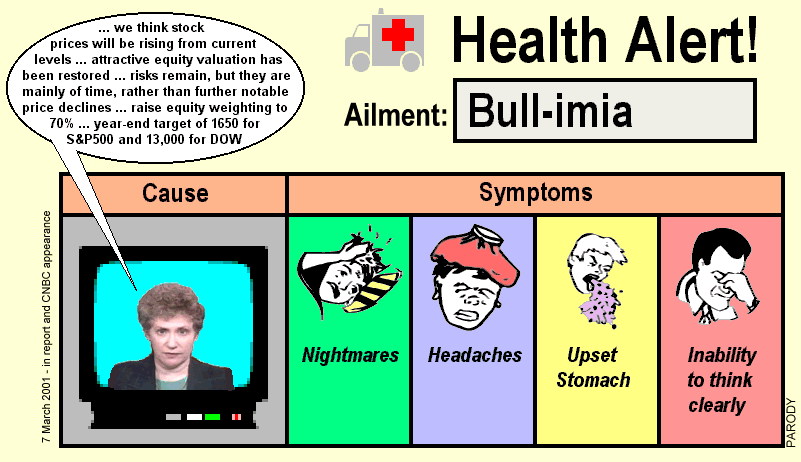
Abby Joseph Cohen 2009 vs Abby Joseph Cohen 2001.....Which Call Is Worse?

What´s a year without a "brilliant" call ( even more important the rationale behind the call ) from Abby Josef Cohen.....Just in time after a 30% plus (technical ) rally in the major indices worlwide.....In the past especially the calls from permabull Cohen were close to near and often long term market tops...... To my knowledge one of the better "contrary" indicators......

Was wäre ein Börsenjahr ohne Weisheiten von Abby Joseph Cohen.....Man beachte das brilliante Timing.... Rechtzeitig nachdem alle bedeutenden Indizes 30% und mehr gewonnen ( technisch bedingt ) haben..... Ein prima Kontraindikator. Die "Prognosen" vom Permabullen Cohen haben in der Vergangenheit zeitlich oft ein längfristiges Markthoch markiert...... Besonders wenn die Begründung für die avisierten Kursziele schon fast tragischkomischen Charakter haben bzw. man befürchten das die Schweinegrippe auch Wall Street erreicht hat...

Call 2001 just bevor the collapse:

bigger/größer

Hat tip Wall Street Follies

Call 2009 S&P 500 at 880:

Goldman Sachs’s Cohen Says S&P 500 May Surge to 1,050

May 1 (Bloomberg) -- The Standard & Poor’s 500 Index may jump 20 percent to 1,050 over the next six to 12 months as investors buy stocks trading at low valuations, said Abby Joseph Cohen, Goldman Sachs Group Inc.’s senior investment strategist.

> Low valuations....? "Fair value based on recession earnings" ( Quote Cohen ) ? She is probably using the following model showing the "high" quality of earnings ( backing out large parts of costs doing business like write downs, restructoring charges etc / see also the update at the end of the posting) or she is the only one thinking the Fed Model ( see "Fed Model" Knowing What Ain't True ) is usefull.....

> Niedrige Bewertungen.....? "Faire Bewertung die auf rezessionsgestählten Ergebnisprognosen basieren" ( Zitat Cohen )? Mag ja sein das sie Ihre Bewertungsmodelle auf der nachfolgenden Rechnungsmodellen basiert die an Kreativität ( "Sonderfaktoren wie Abschreibungen, Restrulturierungskosten usw werden ausgeklammert ) kaum zu überbieten sind ( siehe auch Update am Ende ). Denkbar auch das Sie als einzige dem Fed Modell ( siehe "Fed Model" Knowing What Ain't True ) glauben schenkt...........


“You could see the market sustain at these levels,” Cohen, 57, said in a Bloomberg Radio interview. “We’re going to set a new trading range much higher than the trading range in February and March.”

Cohen was replaced as Goldman Sachs’s chief forecaster for the U.S. stock market a year ago. She had been the second-most bullish Wall Street strategist at the start of 2008, a year when the S&P 500 tumbled 38 percent to 903.25 for the steepest annual loss in seven decades. Cohen predicted in December 2007 that the index would end last year at 1,675. David Kostin took her job.

At least i think her 2009/2010 call will be closer to the target than her over 40 percent miss for the 2008 December estimate...... :-)

Immerhin wird sie wohl Ihre 40% Zielverfehlung Ihrer letztjährigen Prognose verbessern können...... :-)

UPDATE:

This just in from David Rosenberg via Zero Hedge . I highly recommend to read the entire link. Compare this to the call from Cohen.....

Den nachfolgenden Link via Zero Hedge empfehle ich allen die das Kontrastprogramm zu Cohen lesen wollen. Eine realistische und fundierte Marteinschätzung von einem der auch die bisherigen Probleme vorhergesen hat ( David Rosenberg ).

The market, as a whole, cannot be considered cheap

In the meantime, earnings forecasts are being trimmed steadily for the balance of the year. In fact, forward P/E multiple of 15x operating and 30x on reported EPS are not that compelling. So, we do not have a strong valuation argument. We do not have a strong earnings argument.

Compare the following chart with the former S$P500 1675 target from Cohen......

Vergleicht den nachfolgenden Chart mit dem vorherigen Kursziel ( S&P 500 1675 ) von Cohen.....

via Chart Of The Day
While the stock market is up sharply since early March, the economy as well as corporate earnings continue to suffer. Today's chart helps provide some perspective as to the magnitude of the current economic decline. Today's chart illustrates that 12-month, as-reported S&P 500 earnings have declined over 90% over the past 20 months (with over 90% of S&P 500 companies having reported for Q1 2009), making this by far the largest decline on record (the data goes back to 1936). In fact, real earnings have dropped to a record low and if current estimates hold, Q3 2009 will see the first 12-month period during which S&P 500 earnings are negative.

Thursday, October 2, 2008

Chart Of The Day " Depression Index"

I´m not sure if this qualifies for a contrary indicator but the pessimism, fear & volatility are all reaching new historic highs ( see latest cover from Time & Economist & someone told me that even Cramer is telling people to get out of stocks......) signalling maybe a short term bottom or bounce..... Emphasis is on short term.... Either way you look at this it is definitely not a bad time to be a labaled as a notorious Goldbuck..... :-)

Bin mir nicht sicher ob dieser Indikator als ausreicht um als Kontraindikator zu gelten. Wenn man diesen aber mit der allgemeinen Stimmungslage, der umgehenden Angst ( siehe hierzu auch die wunderschönen und treffenden Cover von Time & The Economist ) und der extrem hohen Volatilitätä kombiniert könnte es gut sein das zumindest kurzfristig das schlimmste überstanden ist..... Betonung liegt wohlgemerkt auf kurzfristig...... Unabhängig davon gab es wohl selten eine bessere Zeit als "Goldbuck" beschimpft zu werden...... :-)

Echoes of the Depression / 1929 and all that Economist

AddThis Feed Button